What Support Do International Students Actually Get at US Colleges?
The fall 2025 enrollment snapshot from the Institute of International Education was blunt: new international student arrivals at US colleges dropped 17% compared to a year earlier. At 57% of surveyed institutions, international classes were smaller. When asked why, 96% of those schools pointed to visa concerns. That's not a blip. It's a signal that the relationship between US higher education and the world's students is under real strain — and it puts a hard spotlight on what support actually looks like once a student arrives.
What International Student Offices Actually Do
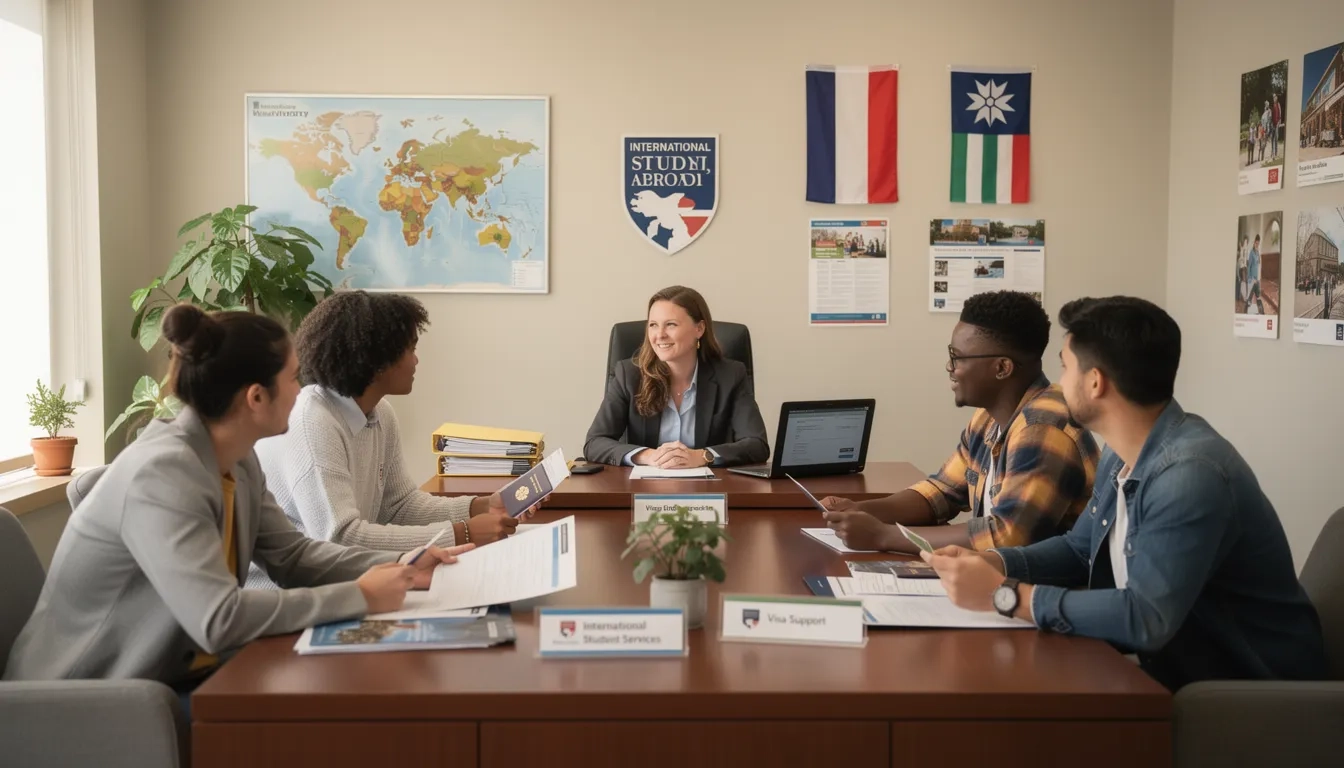
The nerve center of support at any US campus is the International Student Services office (called ISS, ISSS, or OIS depending on the school). Think of it as a combination immigration law firm, cultural welcome center, and bureaucratic translator for every confusing piece of paperwork the US government sends F-1 and J-1 visa holders.
These offices issue I-20 forms, process OPT applications, advise on maintaining legal status, and run the orientation programs that 82% of US universities offer specifically for international students. That separate orientation matters. General orientation wasn't designed with full-time enrollment requirements or tax-filing obligations in mind.
Staff credentials matter here. Look for advisors holding NAFSA: Association of International Educators certifications. It's the professional standard in the field, and schools that invest in credentialed staff tend to invest in the whole program.
| Service Area | Large Research University | Small Liberal Arts College | Community College |
|---|---|---|---|
| Immigration advising | Full-time dedicated staff | Often 1-2 staff, limited hours | Usually minimal or outsourced |
| Mental health (cultural) | Often has specialists | Generalist center, waitlists common | Community referrals only |
| Career/OPT support | Robust, often integrated | Variable | Usually minimal |
| Language support (ESL) | Multiple levels, year-round | Basic or none | Often strong, core mission |
| Need-based aid for intl. students | Rare; merit aid varies | Merit aid sometimes available | Very low tuition baseline |
Immigration Advising: The Backbone of Any Good Program
F-1 visa rules are genuinely unforgiving. A student who drops below full-time enrollment without authorization from their DSO (Designated School Official) can fall out of status. Working off-campus without proper paperwork can trigger removal proceedings. The rules don't soften for honest mistakes.
Good immigration advisors are worth their weight in gold. They explain the difference between CPT (Curricular Practical Training) and OPT in plain English, walk students through travel signature requirements before international trips, and flag problems before they become crises.
The current policy environment has raised the stakes considerably. Student visa issuances fell 36% in summer 2025, according to ICEF Monitor data. Social media vetting became part of standard immigration processing in 2025. F-1 renewals now require in-person consulate interviews — a reversal of the interview waiver policy many students had relied on for years.
Before committing to a school, ask specific questions: Does the ISS office publish advising response time targets? Can you get urgent advising for status emergencies without a week's wait? Is the staff-to-student ratio below 1 advisor per 300 enrolled international students? Anything worse than that ratio is worth probing further.
Academic Help: Where Most Students Start (and Often Stop)
The academic transition for international students isn't purely about English proficiency. It's about different educational systems. Students from countries where professors lecture and students absorb often land in US classrooms that grade on participation, expect original arguments in papers, and treat debate with instructors as normal. That culture shock is real.
Writing centers are probably the single most underused resource on any US campus. They exist at nearly every accredited four-year school, work with students at any stage of the writing process (not just correcting grammar at the end), and are equipped to help students whose first language isn't English understand argument structure and citation norms.
Beyond writing support, the strongest programs offer:
- Peer and professional tutoring for STEM courses, where conceptual frameworks can differ significantly from other countries' curricula even when language isn't the barrier
- English conversation programs, often volunteer-matched with domestic students
- Academic advising from someone who understands how course loads interact with visa requirements, not just degree checklists
One pattern that shows up repeatedly: students spend their first semester not asking for help because asking feels culturally unfamiliar. By the time they recognize they're behind, the semester is nearly over. Schools that proactively reach out to new international students in weeks two and three — rather than waiting for students to self-identify — catch this earlier.
Mental Health: The Biggest Unmet Need
The gap between what universities offer and what international students actually use is widest here. By a significant margin.
Research published in Frontiers in Psychiatry in 2025 found depression rates among international university students ranging from 3.6% to 51.5% across different populations, with loneliness rates between 60% and 65%. Yet only 13.1% of postgraduate international students in one study sought mental health support despite elevated distress levels.
Why the gap? Mental health treatment carries stigma in many cultures that doesn't disappear once you're on a US campus. University counseling centers operate on assumptions about self-disclosure and the therapeutic relationship that can feel foreign to students from collectivist backgrounds. And wait times at many centers stretch into weeks.
International students are less likely than their domestic peers to use counseling services even when experiencing greater psychological distress. The problem isn't availability — it's connection.
The most effective interventions are peer-based. Students trust other students who share their background more readily than they trust clinical strangers. Schools like UCLA and the University of Michigan have built international student mental health liaisons directly into their counseling centers. Some programs now pair telehealth options with counseling available in students' native languages.
Low-barrier entry points work better than high-barrier ones. Mental health apps, group workshops, peer support organized around regional or national identity — these reach students who would never walk into a counseling office on their own. Faculty training to recognize distress signals in students who won't self-disclose is another piece that more schools are starting to build out.
Career Services and the OPT Minefield
For most international students, the US degree is partly a pathway to US work experience and longer-term career options. Optional Practical Training — 12 months of post-graduation work authorization, or 36 months for STEM graduates — is the bridge that connects the degree to what comes next.
The bridge is under strain. USCIS has increased site visits to verify actual employment at OPT workplaces, cracking down on fake employer schemes. Potential rule changes could restrict or eliminate the STEM OPT extension entirely. Students at schools with weak career services are working through this alone, often without knowing what a legitimate OPT training plan looks like or how to identify employers who actually sponsor H-1B visas.
Good career centers do three things that matter for international students:
- Help students identify employers with H-1B sponsorship history — this data is publicly available in USCIS employer disclosure files, but it's hard to parse without guidance
- Run OPT application workshops timed to graduation cycles, not just posting USCIS instructions on a webpage
- Connect students with alumni networks that include people who've navigated this pathway successfully
One number worth sitting with: IIE data shows roughly one in four people counted as "international students" in the US is actually an OPT participant who already graduated. Schools that count these alumni in enrollment numbers aren't necessarily supporting them in any meaningful ongoing way. That's a gap worth asking about directly.
How to Evaluate a School's Support Before You Enroll
University websites describe international student support in glowing, vague terms. Getting past the marketing requires specific questions — asked at admitted student events or by email, before you commit.
Questions that cut through the noise:
- What's the average wait time for an immigration advising appointment during peak periods (September and January)?
- How many DSOs are on staff relative to enrolled international students?
- Is there a dedicated international student mental health counselor, or do all students share a generalist center?
- What's your OPT authorization rate, and has USCIS scrutiny affected your STEM OPT students recently?
Look for structural signals of real investment:
- A standalone International Student Center with its own physical space (not a desk in the admissions office)
- An international student advisory board or formal representation in student governance
- Published outcome data — graduation rates, OPT authorization rates, visa compliance records
The fall 2025 data showed 277,118 new international students commenced studies at US universities that year. The schools those students chose had reputations that preceded them. Before paying application fees, it's worth doing the research to figure out which schools earned those reputations and which ones coasted on them.
Bottom Line
The support landscape at US colleges is uneven. Some schools have built genuinely strong programs with credentialed immigration advisors, culturally aware mental health resources, and career services that understand the OPT pathway. Many others have not, and the difference is consequential.
- Know your ISS office before your first week of class. Every visa question, every status concern, every OPT filing runs through your DSO. Get their contact information at orientation, not when something goes wrong.
- Use the writing center early — one appointment per major assignment is a reasonable habit to build in your first semester, before it's urgent.
- Don't wait for a mental health crisis to engage with support. If your school runs international student peer groups or mental health workshops, attend in the first semester. You'll know where to go if things get difficult.
- Start mapping your career pathway by the end of year one. Students who understand OPT requirements, H-1B timelines, and which employers historically sponsor international hires have better options than those who figure it out at graduation.
- When choosing a school, treat international student support quality as a core admissions factor. The difference between a well-staffed ISS office and a two-person operation serving 2,000 international students can determine whether you stay in legal status, graduate on time, and build a career here.
Frequently Asked Questions
What is an I-20 form and why does every international student need one?
The I-20 is a Certificate of Eligibility for Nonimmigrant Student Status, issued by your school's DSO. It's the document that ties your F-1 visa to your specific school and program. Without a valid, current I-20, you can't legally maintain student status. You'll update it through your ISS office multiple times during enrollment — when changing programs, extending studies, or applying for OPT — so understanding this process early matters.
Do US colleges offer financial aid to international students?
Most federal aid, including Pell Grants and subsidized loans, is unavailable to international students. However, many private universities offer institutional merit scholarships that are open to international applicants. A small number of schools — MIT and Amherst College among them — meet 100% of demonstrated financial need for international students regardless of citizenship. These schools are highly selective, and applicants should verify current policy directly before treating it as a planning assumption.
How long does OPT authorization take, and when should I apply?
USCIS processing times for OPT applications currently run 3 to 5 months from submission. Students can apply up to 90 days before their graduation date. Most ISS offices recommend applying as early as allowed. Waiting too long, or misunderstanding the timeline, is one of the most common and most preventable problems international students face in their final year.
Is the mental health stigma around counseling getting better for international students?
Slowly. Awareness programs have expanded across US campuses, and some schools now offer counseling in multiple languages or through therapists with shared cultural backgrounds. But utilization rates remain lower for international students than for domestic students even when distress levels are higher. The interventions that work best tend to be peer-based rather than clinical — and schools are increasingly building these alongside, not instead of, formal counseling programs.
What should I do if my visa application or renewal is denied?
Contact your ISS office immediately. They can verify your I-20 is accurate, clarify your current status, and connect you with immigration attorneys if needed. Your school may have referral partnerships for exactly this situation. The most important rule: don't attempt to re-enter the US on an expired or invalid status. The consequences are serious and can bar future entry for years.
How much are current US immigration policies affecting international enrollment?
The impact is measurable. NAFSA's fall 2025 snapshot found the 17% drop in new international enrollment translated to $1.1 billion in lost revenue and nearly 23,000 fewer US jobs supported. Social media vetting requirements, mandatory in-person consulate interviews for F-1 renewals, and STEM OPT uncertainty have all added friction. Schools with strong ISS offices are staying current on policy changes and communicating them proactively to admitted students — that responsiveness is itself a signal worth watching for.
Sources
- IIE Open Doors 2025 Press Release — United States Hosts 1.2 Million International Students
- ICEF Monitor: International Students in the US in 2024-25, But Commencements Are Declining
- Frontiers in Psychiatry: Navigating Mental Health Challenges in International University Students (2025)
- WENR: Slowing Growth and Uncertainty — Open Doors 2024 Analysis
- NAFSA: Fall 2025 International Student Enrollment Snapshot & Economic Impact
- ICEF Monitor: US Student Visa Issuances Fell 36% in Summer 2025
- Amerigo Education: International Student Support Services Complete Guide 2026