Delaware FAFSA Deadlines & State Aid Programs for 2026
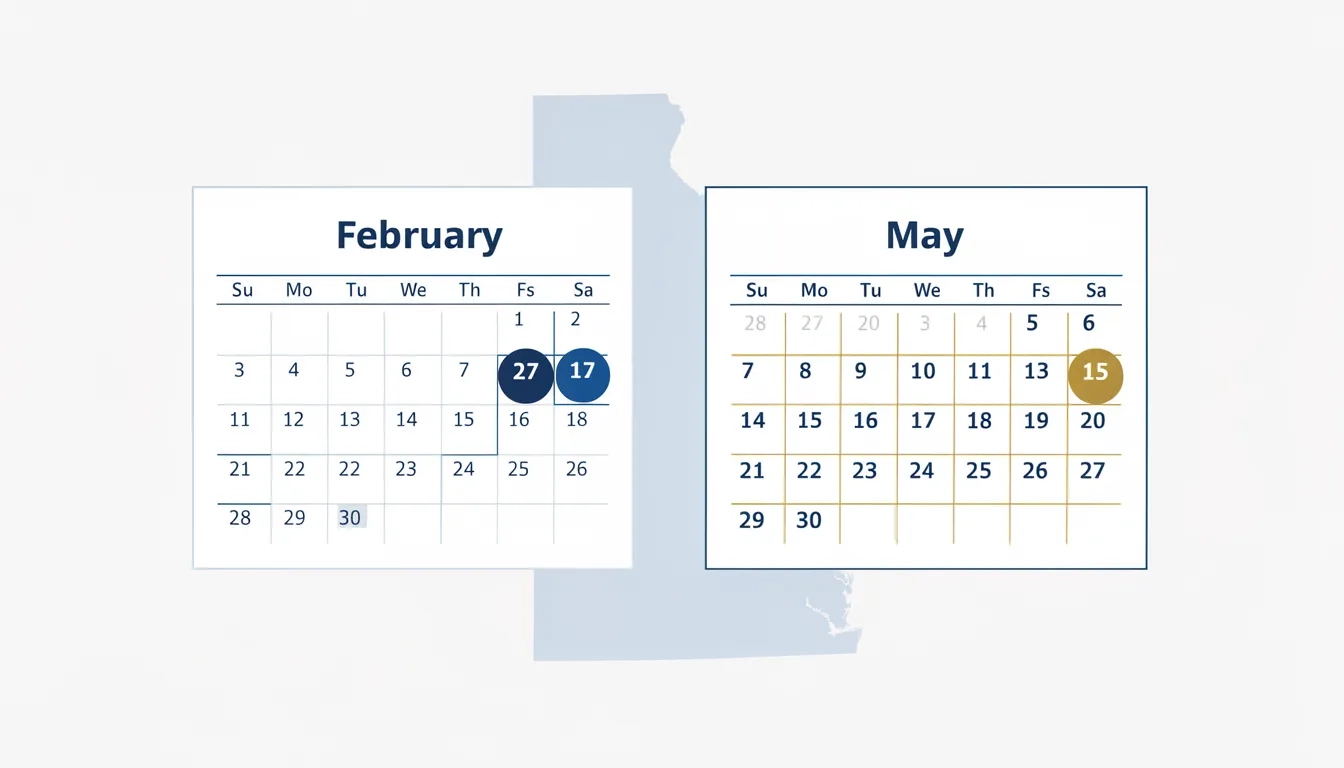
Delaware doesn't have one FAFSA deadline for state aid. It has two, and conflating them is the most expensive mistake a student can make. Miss February 27 and you're locked out of the full-ride scholarships entirely. Miss May 15 and the need-based grants disappear too. Most families never hear that the state runs nine separate programs through the Delaware Higher Education Office, each with distinct award amounts, GPA thresholds, and FAFSA rules. Here's what you actually need to know.
The Two Deadlines That Define Your Options
February 27, 2026 at 4:30 p.m. is when Delaware's competitive academic scholarships close. These are the high-stakes programs, the ones that cover full tuition, room, board, and books. There is no appeals process, no waitlist, no grace period. The portal closes, and it stays closed.
May 15, 2026 at 4:30 p.m. covers the need-based and career-focused programs. Later, yes, but still 46 days ahead of the federal FAFSA deadline (June 30, 2027). Treating May 15 as your fallback plan after missing February is not a strategy.
The federal deadline protects your Pell Grant eligibility and federal loan access. The state deadlines protect access to Delaware's own scholarship money. These are separate systems, and only one of them will help you pay for a Delaware school.
The February 27 Scholarships: Three Awards, One Hard Deadline
All three programs that close on February 27 are administered by the Delaware Higher Education Office and target high school seniors specifically.
The B. Bradford Barnes Memorial Scholarship is the one every Delaware student should know by name. It covers full tuition, fees, room, board, and books at the University of Delaware — a package that runs above $28,400 per year for in-state on-campus students. You need a minimum 3.0 unweighted GPA, an SAT score of at least 1290 (or the ACT equivalent), and demonstrated financial need. Your FAFSA must be submitted and linked to your Delaware portal application before 4:30 p.m. on February 27.
The Herman M. Holloway Sr. Memorial Scholarship mirrors the Barnes in structure but routes students to Delaware State University instead. The SAT threshold drops to 1000, which opens the door for more applicants. Coverage is identical — full tuition, fees, room, board, and books — and so is the financial need requirement. Same deadline.
The Charles L. Hebner Memorial Scholarship works differently. It pays $1,250 per year (renewable for up to three years), with roughly 35 students winning it annually. It applies to any regionally accredited institution, not a specific school. The key difference: no FAFSA is required for Hebner — just the online application and the academic criteria.
| Scholarship | Award | SAT Minimum | Financial Need | Institution | FAFSA? |
|---|---|---|---|---|---|
| Barnes Memorial | Full ride (tuition + room + board) | 1290 | Yes | University of Delaware only | Yes |
| Holloway Memorial | Full ride (tuition + room + board) | 1000 | Yes | Delaware State University only | Yes |
| Hebner Memorial | $1,250/year | 1290 | No | Any accredited college | No |
All three require a minimum 3.0 unweighted GPA. All three are renewable for up to three additional years with that same GPA maintained.
The May 15 Programs: Broader Access, Still Meaningful Money
The May 15 cluster is larger and more varied. These programs serve current college students, graduate students, and anyone pursuing a career in a high-demand field.
The Scholarship Incentive Program (ScIP) is Delaware's most distributed award. About 750 students receive it annually at $1,000 per year, and you can earn up to five awards across your academic career. The requirement is demonstrated financial need (your FAFSA-generated Student Aid Index determines this) and full-time enrollment at a Delaware institution.
There is one exception to the in-state rule. If your specific program isn't available at any Delaware institution, ScIP can apply to an out-of-state school. Attending an out-of-state school by preference alone doesn't count — but a specialized field with no Delaware equivalent likely does.
Career-based Scholarships target specific high-demand majors:
- Accounting, finance, business administration
- Computer engineering, computer science, data science and analytics, information technology
- Healthcare management, nursing, operations management
Award amounts vary annually based on the applicant pool. You must be a full-time bachelor's student at a Delaware institution with demonstrated financial need.
The Educator Support Scholarships run on two tracks. The undergraduate version covers early childhood special education, foreign language, bilingual education, math, science, English Language Learner instruction, and special education. The graduate version adds school counselors, school nurses, school psychologists, and school social workers — and graduate students can apply part-time, with the award prorated accordingly.
A Speech-Language Pathologist Scholarship exists for full-time graduate SLP students at Delaware institutions, with amounts set each year based on available state funding.
Two Programs That Work Differently
The SEED Scholarship gives Delaware high school graduates access to tuition-free associate degree programs at Delaware Technical Community College or through the University of Delaware's Associate in Arts program. FAFSA is required each year to confirm need eligibility, but the competitive academic thresholds from the February programs don't apply. For students looking for a debt-light path to a bachelor's degree (or a credential on its own), SEED is genuinely underused.
Educational Benefits for Children of Deceased Veterans covers full tuition and fees at Delaware public institutions for up to four years. Applicants must be between 16 and 24, have lived in Delaware for at least three consecutive years, and have a parent who died in active military service or was a Delaware state employee killed in the line of duty. The prior year's FAFSA is collected during the review process but isn't the primary eligibility factor.
How the Application Process Actually Works
Every Delaware state scholarship except SEED runs through one portal: the Delaware Higher Education Financial Aid Portal at education.delaware.gov. You submit one application; the system matches you to eligible programs automatically. (The application itself takes roughly 20 minutes once you have your FAFSA confirmation and transcript information ready.)
Here's the sequence that works:
- File the 2026-2027 FAFSA at studentaid.gov, designating Delaware's state agency during the submission
- Create an account on the Delaware Higher Education Financial Aid Portal
- Complete the scholarship application, which asks for GPA, test scores, intended major, enrollment status, and school
- Submit official transcripts as directed through the portal
- Confirm your submission before 4:30 p.m. on the applicable deadline day
One detail that bites people: FAFSA data takes 3–7 business days to transfer from the federal system to Delaware's portal. Filing FAFSA the morning of February 27 will not give you enough time for the data to confirm before 4:30 p.m. Build in at least two weeks of buffer.
The Mistakes That Actually Cost Students Money
The most common error is treating May 15 as a recovery from missing February 27. It isn't. Students who miss the competitive scholarships and pivot to ScIP have lost access to the full-ride programs permanently for that cycle. No amount of need-based aid replicates a Barnes or Holloway award.
GPA miscalculations trip up applicants for the February 27 scholarships. Delaware requires an unweighted GPA. A student with a 2.9 unweighted average who thinks their weighted 3.4 qualifies will be rejected.
Students consistently leave money on the table by not applying for the Educator Support Scholarships. Delaware has dedicated scholarship money for math, science, and special education teaching candidates that goes undersubscribed some years — not because the funding runs out, but because eligible students never apply.
The Delaware Higher Education Financial Aid Portal matches you to awards automatically. But only if you apply. No application, no match. That's the part most students don't hear until after the deadline passes.
Families also often assume they don't qualify for need-based aid without running the numbers. Delaware's average on-campus cost of attendance runs about $28,400 per year for in-state students. The gap between that figure and most families' expected contribution is wider than people assume, especially for middle-income households.
My Read: File the FAFSA in October
Here's a clear position: filing your FAFSA the week the form opens in October 2025 is the single highest-return action a Delaware student can take. It costs nothing, takes under an hour, and it's the only way to confirm that your data flows correctly to Delaware's portal well before either state deadline.
Waiting until late January or February to file because "the deadline feels far away in October" is exactly how students end up refreshing a federal confirmation page at 4:00 p.m. on February 27 wondering if the data transferred in time. It usually hasn't.
The Delaware Higher Education Office runs a genuinely well-organized state scholarship system. Nine programs, clear criteria, one portal. But even a well-organized system can't help students who showed up after the window closed.
Bottom Line
- File your 2026-2027 FAFSA in October 2025 — weeks before either Delaware deadline — so your data confirms in the state portal without a scramble.
- February 27, 2026 at 4:30 p.m. is your target for the Barnes, Holloway, and Hebner scholarships. No extensions exist.
- May 15, 2026 at 4:30 p.m. covers ScIP, Career-based, Educator Support, Speech-Language, and Veterans' programs.
- All applications go through the Delaware Higher Education Financial Aid Portal at education.delaware.gov — one application, matched to multiple programs.
- Don't assume you earn too much for need-based aid. File the FAFSA and let your Student Aid Index tell you the actual number.
Frequently Asked Questions
What is Delaware's state FAFSA deadline for 2026?
Delaware operates on two state deadlines. High school seniors pursuing competitive scholarships (Barnes, Holloway, and Hebner) must apply by February 27, 2026 at 4:30 p.m. Students applying for need-based or career-based programs have until May 15, 2026 at 4:30 p.m. The federal FAFSA cutoff of June 30, 2027 does not preserve eligibility for any Delaware state programs.
Can Delaware students receive state aid at an out-of-state college?
It depends on the program. The Hebner Memorial Scholarship applies to any regionally accredited institution. ScIP can apply to out-of-state enrollment if your specific program of study isn't available at any Delaware institution. Most other programs require attendance at a Delaware institution.
Does Delaware offer a free community college option?
Yes. The SEED Scholarship covers tuition for Delaware high school graduates at Delaware Technical Community College or through the University of Delaware's Associate in Arts program. FAFSA is required annually, but the competitive GPA and SAT thresholds from the bigger February awards don't apply to SEED.
Is the FAFSA required for all Delaware state scholarships?
No. The Hebner Memorial Scholarship does not require a FAFSA — only the scholarship application, a 3.0 unweighted GPA, and an SAT score of at least 1290. All other major Delaware awards, including Barnes, Holloway, ScIP, and the Educator Support scholarships, require an active FAFSA linked to Delaware's portal.
What happens if I file my FAFSA on the actual deadline day?
FAFSA data takes 3–7 business days to transfer to Delaware's portal. Filing on February 27 itself leaves no time for the data to confirm before the 4:30 p.m. cutoff. The safest approach is having your FAFSA submitted and confirmed at least two weeks before any Delaware scholarship deadline.
Are the Career-based and Educator Support Scholarships renewable?
Yes, with conditions. You need to maintain full-time enrollment in an eligible major and continue to demonstrate financial need each year. For Educator Support scholarships, you must remain in a qualifying subject area. If your major changes to an ineligible field, you lose that specific award — though you may still qualify for ScIP or other need-based programs.
Sources
- State Scholarships for DE Residents — Delaware Student Success
- DHEO Scholarships — Delaware Department of Education
- 2026-27 Financial Aid and FAFSA State Deadlines — Fastweb
- When is the 2026-2027 FAFSA Deadline? — Scholarships360
- Important FAFSA Deadlines for 2025-2026 and 2026-2027 — Saving for College
- FAFSA and Free Support — Delaware Student Success