What Happens If You Miss the FAFSA Deadline
Most students assume June 30 is the deadline — the one date that separates "covered" from "not covered." That assumption is costing people thousands of dollars. By the time June 30 becomes relevant, you've almost certainly already missed the deadlines that controlled the most money. This is the thing nobody explains clearly, and it's worth getting straight before you do anything else.
The Three-Deadline System Nobody Tells You About
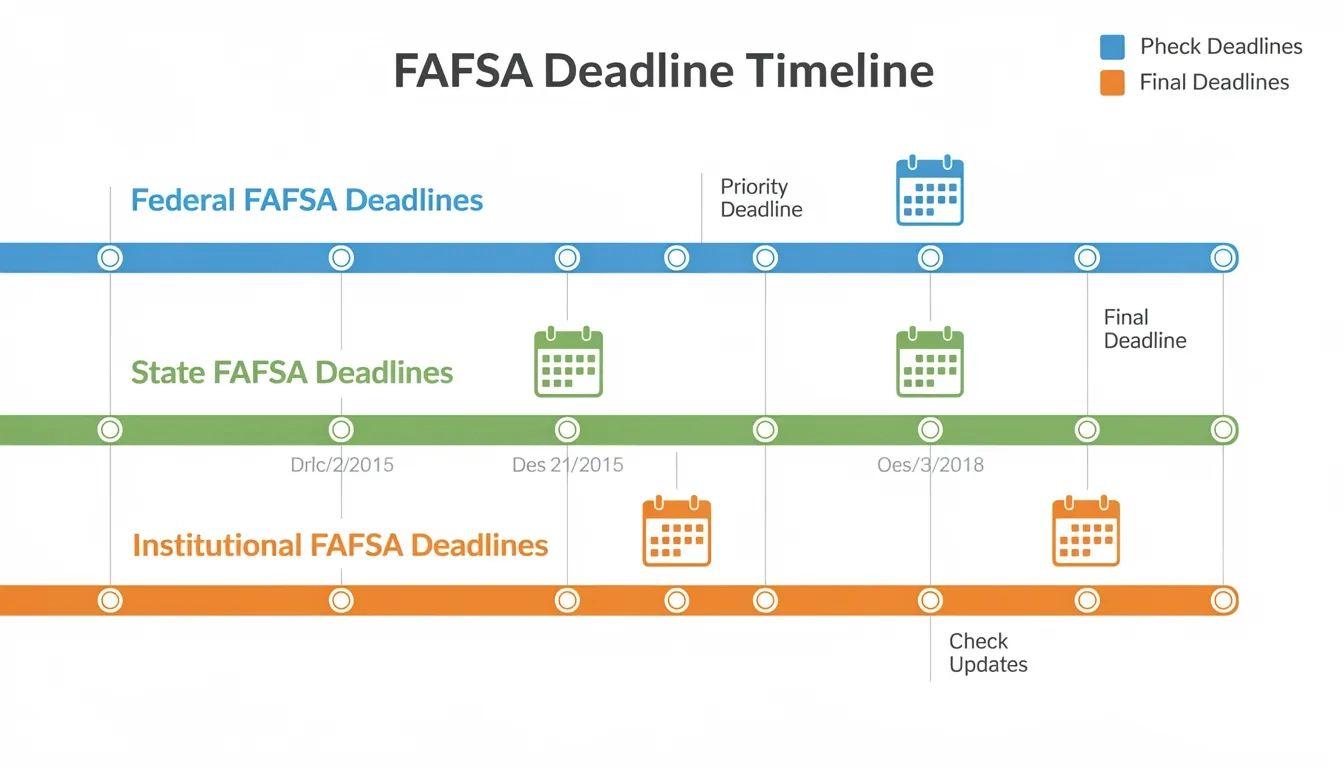
Federal, state, and institutional deadlines are three separate tracks that run simultaneously. Each controls different money. Missing any one of them has different consequences.
The federal deadline is June 30 of the award year. For the 2025-26 award year, that's June 30, 2026. Miss this date and FAFSA closes — you physically cannot submit. Federal Pell Grants, subsidized loans, unsubsidized loans — gone for the year.
State deadlines vary by state and often land months before June 30. Ohio's OCOG grant deadline is October 1. California's Cal Grant deadline is March 2. Connecticut's is February 15. These aren't suggestions. Most state grant programs don't offer second chances once the deadline passes.
Institutional deadlines are set by individual colleges, and they're usually the earliest of all three. Schools often want your FAFSA by late January or February to package institutional aid — the grants and scholarships that come from the school's own endowment, not the federal government.
Most people only know about June 30 because it's the one advertised most heavily. Focusing exclusively on that date means you're already thinking too late.
Here's the structural reason this matters: a significant portion of federal student aid — including campus-based programs like Supplemental Educational Opportunity Grants (SEOG) and Federal Work-Study — gets allocated to schools in a fixed lump sum at the start of each award year. Schools distribute these funds on a rolling first-come, first-served basis. Once the money runs out, it's gone regardless of whether June 30 is still weeks away.
What You Actually Lose — By Deadline Type
The consequences aren't uniform. Which deadline you missed, and by how long, determines the damage.
Missing your school's priority deadline usually means your application still gets processed, but campus-based funds may already be committed. Your aid package might arrive smaller or later, and certain grants (especially SEOG) might not appear at all. Most schools won't tell you this directly unless you ask.
Missing your state deadline is often the most underappreciated loss. State grants don't require repayment. They're free money. California's Cal Grant can be worth up to $9,708 per year for students at UC campuses (for 2025-26). Miss March 2 and that program closes to you for the year, regardless of your need or income. Other federal options may still be available, but that particular grant money is not coming back.
Missing the federal June 30 deadline is the unrecoverable scenario. There is no appeals process. You cannot retroactively qualify for federal aid for a closed award year.
Students who submit FAFSA in the first three months of the filing window receive twice as many grants, on average, as students who file later. The difference isn't just about hard deadlines — it's about the rolling depletion of limited funds.
Here's how the three scenarios stack up:
| Deadline Missed | Aid at Risk | Can You Recover? |
|---|---|---|
| School priority deadline | Institutional grants, SEOG, Work-Study | Sometimes — call immediately |
| State deadline | State grants (Cal Grant, OCOG, etc.) | Rarely |
| Federal deadline (June 30) | All federal aid for the year | No |
State Deadlines Are the Hidden Trap
This is where most students get blindsided. State deadlines are inconsistent, poorly publicized, and — in some cases — brutally early.
Fourteen states distribute grants on a first-come, first-served basis starting October 1, meaning there's no posted cutoff date so much as a pool that empties over time. Alaska, Illinois, Indiana, Kentucky, Nevada, and North Carolina are among them. Filing in late March in one of these states might work fine, or the fund might be dry. You won't know until you check.
States with fixed earlier deadlines are arguably more straightforward, just painful:
- Ohio — October 1 (OCOG grant)
- California — March 2 (Cal Grant)
- Michigan — March 1
- North Carolina — March 15
- Connecticut — February 15
Texas follows the federal June 30 deadline with no separate state cutoff, which makes it one of the more forgiving states for late filers. Florida extends to July 28 for merit-based scholarships like the Bright Futures Scholarship (though Florida Financial Aid applications have their own separate deadline structure).
The safest approach: look up your state directly on the Federal Student Aid website at studentaid.gov, not a third-party guide. State programs update their deadlines annually, and the secondhand information circulating online is frequently one cycle behind.
If You've Already Missed — Do This Now
The clock is ticking, but the situation isn't necessarily hopeless. The right steps depend on which deadline you missed.
If you missed your school's priority deadline:
- Submit the FAFSA right now if you haven't. Even partial funds may remain.
- Call the financial aid office — not email, call. Ask specifically whether campus-based funds are still available and what your options are for late applicants.
- Ask about a professional judgment review. If your financial situation changed significantly (job loss, divorce, medical crisis), schools have legal discretion to adjust your aid package based on documented circumstances. This is underused and worth requesting explicitly.
If you missed your state deadline:
- Still submit your FAFSA to preserve federal eligibility.
- Contact your state's higher education agency directly. Some programs maintain limited appeals processes for extenuating circumstances, though most don't.
- Search your state's separate scholarship databases. Many states fund scholarship programs that operate entirely outside the FAFSA system and have their own, later deadlines.
If you missed the federal June 30 deadline:
Your options now sit entirely outside federal aid:
- Institutional grants from your school
- Private scholarships (no FAFSA required)
- Private student loans
- Payment plans through your bursar's office
- Income-share agreements offered by some institutions
The FAFSA for the next award year reopens in the fall. You'll be eligible again — for the next year.
Alternative Funding When Federal Aid Is Gone
Losing access to federal aid for a year is genuinely difficult. But students patch together funding from alternative sources more often than you'd think.
Private scholarships are the most underused option in this situation. Databases like Fastweb and the College Board's Scholarship Search list thousands of awards that require no FAFSA documentation whatsoever. Deadlines are scattered throughout the year, not clustered in spring like federal and state aid. A focused search for 37 hours across one month has resulted in students locating several thousand dollars in awards — the work-to-reward ratio is real.
Institutional aid often operates on a different timeline from federal programs. Private colleges with substantial endowments frequently maintain emergency bridge grants and interest-free short-term loans for students in financial distress. MIT Student Financial Services, for instance, explicitly states there are no penalties for late applications and reviews submissions on a rolling basis through mid-May. Many schools have similar (if less publicized) policies. Ask directly.
Installment payment plans through the bursar's office let you break tuition into monthly payments with no interest. This doesn't solve the funding gap, but it preserves enrollment while you work the other angles.
Some students choose to take a lighter course load, pick up additional work hours, or take one semester off to get finances in order. That's not failure. For many people it's the financially sound decision, especially if the alternative is private loans at 11-13% interest.
How to Never Be in This Position Again
If you're reading this because you already missed a deadline, the lesson is learned. If you're reading ahead of time, here's how to build a system that prevents the problem.
Know your three dates specifically. Not "sometime in spring." Write down the exact date your school wants FAFSA, your state's deadline, and June 30. Set phone reminders 6 weeks and 2 weeks before each.
File as early as possible after the FAFSA opens. The 2026-27 filing window opened September 24, 2025 — earlier than the traditional October 1 date. Early filers get the widest access to limited funds.
Don't wait on your taxes. FAFSA uses prior-prior year tax data, meaning you're filing with returns that are already complete. There's almost never a valid reason to wait until spring.
Use the IRS Data Retrieval Tool when filling out the form. It pulls your tax data automatically, cuts errors, and reduces the chance your application gets flagged for verification — a process that can delay aid disbursement by weeks.
The students who secure the most aid aren't always the ones with the lowest income. They're the ones who file first. That's the honest takeaway from how this system works, and it doesn't change year to year.
Bottom Line
- Missing June 30 locks you out of all federal aid for that award year — Pell Grants, subsidized loans, everything. No exceptions, no appeals.
- Missing state and school deadlines (which come earlier) is the more common mistake, and it can mean losing grants that never have to be repaid.
- If you've already missed a deadline, call your school's financial aid office today and ask specifically about remaining campus-based funds, professional judgment reviews, and emergency institutional grants.
- Private scholarships, institutional aid, and bursar payment plans are real alternatives — imperfect, but workable.
- Next year: file in October, not March. That single habit captures more aid than any other strategy.
Frequently Asked Questions
Can I still get federal financial aid if I miss my state's FAFSA deadline?
Yes. State and federal deadlines are separate. Missing your state's deadline (like California's March 2 Cal Grant cutoff) means you lose state grant eligibility, but you can still submit FAFSA before June 30 to qualify for federal Pell Grants and federal student loans. The two programs run independently.
Is there any way to get aid after the June 30 federal deadline?
No federal aid is available after June 30 for that award year — the FAFSA form closes entirely. Your remaining options are institutional grants from your school, private scholarships that don't require FAFSA, private student loans, and payment plans through your bursar's office. The next year's FAFSA opens in the fall, so you won't wait long to re-establish eligibility.
My school has a priority deadline — is that the same as the actual deadline?
No, and this confusion costs people money. A priority deadline is when the school guarantees full consideration for its own institutional funds (grants, work-study slots, SEOG). After that date, the school may still process your FAFSA, but campus-based funds may already be committed to earlier applicants. You'll likely still qualify for federal Pell Grants and loans, but the school's own grants may be reduced or gone.
Myth vs. Reality: Does filing FAFSA guarantee you'll receive financial aid?
Myth. Filing FAFSA determines your eligibility — it doesn't guarantee you receive any specific amount. Aid is a combination of eligibility, available funds at your school, and timing. Students who file early when campus-based aid pools are full consistently receive more than late filers with identical financial need. Eligibility doesn't equal a check; it opens the door to funds that deplete over time.
What is a professional judgment review, and who qualifies?
A professional judgment review (sometimes called a special circumstances appeal) allows a school's financial aid administrator to adjust your FAFSA data to reflect significant changes in your family's financial situation — job loss, death of a parent, major medical expenses, or divorce. Not every school offers this for late applicants, but it's worth asking about directly. Submit documentation (termination letter, medical bills) when you request the review to move the process faster.
Should I bother submitting a late FAFSA if state aid is already off the table?
Yes. Federal Pell Grant eligibility, subsidized loan access, and any remaining institutional aid from your school all require an active FAFSA. A late submission beats no submission. Even if your state funds are gone, you're still protecting access to significant federal programs — and your school may still have funds available if you're not deep into the semester.
Sources
- 3 FAFSA Deadlines You Need To Know Now – Federal Student Aid
- Important FAFSA Deadlines for 2025-2026 and 2026-2027 – Saving for College
- FAFSA Deadlines and What Happens if You Miss Them – Concorde Career Colleges
- What Happens If I Miss the Financial Aid Deadline – MIT Student Financial Services
- FAFSA Deadline 2026: State-by-State Guide – The College Monk