From GED to Degree: Supporting Formerly Incarcerated Students in College
Seventy-three percent of GEDs earned by incarcerated people are earned behind bars. And then, for most, almost nothing happens. According to the Prison Policy Initiative, only 9.6% of those GED holders pursue any college coursework after release. Fewer than 1% ever earn a degree. That gap — between the ambition it takes to study in a prison classroom and the reality of what follows — tells you almost everything about how poorly the system supports this transition.
The Scale of the Problem
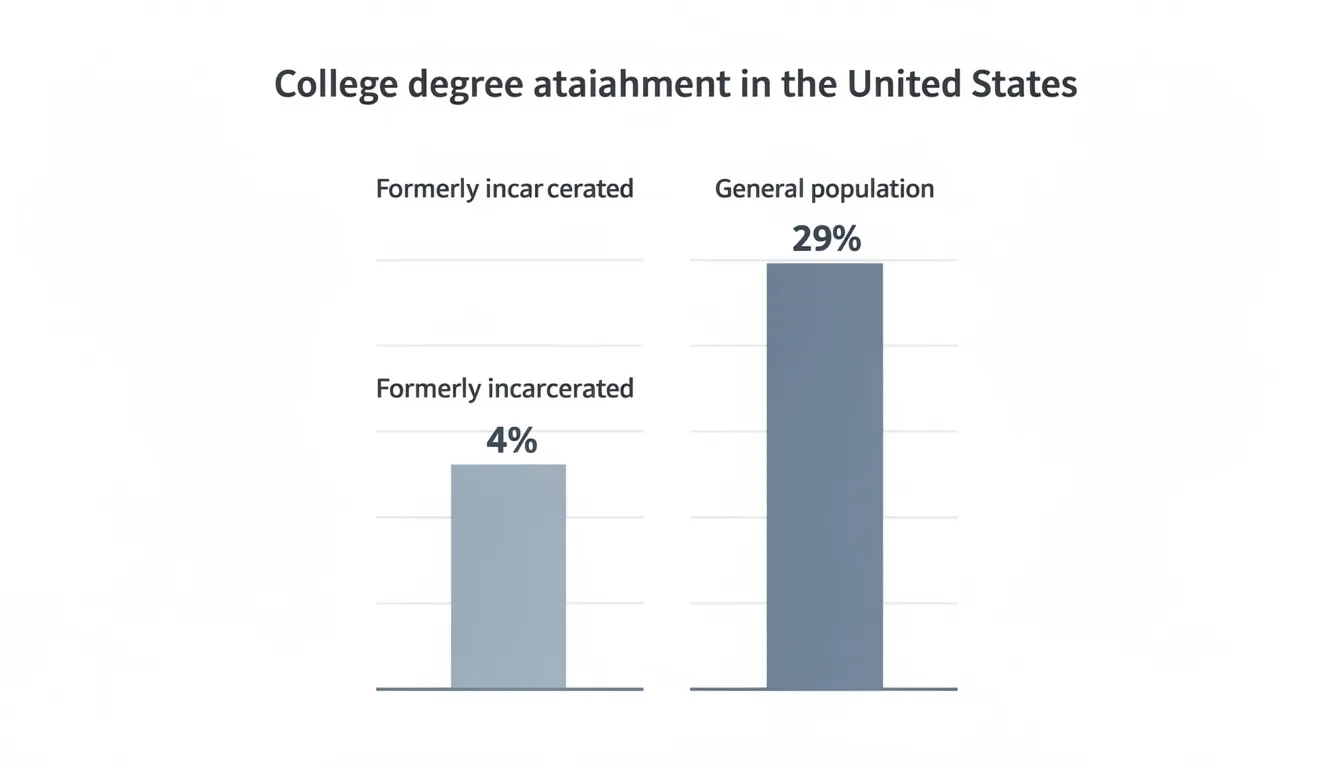
Less than 4% of formerly incarcerated people hold college degrees, compared to 29% of the general population. That's not a small disparity. It's a chasm, and it compounds itself, because education is one of the strongest predictors of whether someone stays out after release.
A RAND Corporation meta-analysis found that incarcerated people who earn an associate's degree have a 13.7% recidivism rate, against roughly 68% for the general released population. Bachelor's degree holders: 5.6%. The master's degree data in that study? Zero percent recidivism. That is not a typo.
The Prison Policy Initiative put the overall unemployment rate for formerly incarcerated people at 27% — higher than the U.S. national rate at the worst point of the 2008 financial crisis. For Black women without high school credentials, unemployment climbs to 60%. Hispanic women in the same situation: nearly half are unemployed.
These numbers don't exist in isolation. No degree means fewer job options. Fewer stable jobs mean fewer stable lives. The cycle has a well-documented anatomy, and education interrupts it more reliably than almost any other intervention.
The Barriers Are Stacked, Not Scattered
Ask a formerly incarcerated person what's hardest about going to college, and you'll probably hear "everything" before you'll hear one specific thing. The obstacles don't arrive one at a time.
The college application itself can be a wall. Many schools still ask about criminal history upfront, before a student can demonstrate anything about who they are now. The research is clear on what this does: it doesn't just filter — it discourages applications entirely. Students who earned credentials in prison, who clearly want education, walk away before submitting a single form.
Then there's housing. Most states still allow landlords to reject tenants based on conviction history. Without stable housing, college becomes practically impossible. You can't write a term paper from a shelter with a midnight curfew, and you can't hold an 8 a.m. class when you're sorting out where you'll sleep.
Technology access is the elephant in the room that campus IT departments rarely account for. Years inside often mean zero experience with learning management systems, cloud storage, or even basic email navigation. Walking into a college library and facing a Canvas portal or a Zoom class for the first time — with no orientation, no one to ask — can end an enrollment before the semester finishes.
Beyond the practical, there's an identity layer. CUNY's Institute for State & Local Governance found that stigma and self-doubt were among the most persistent obstacles students named, sitting alongside career guidance gaps and the sheer weight of competing survival priorities after release.
| Barrier | Why It's Harder Than It Looks |
|---|---|
| Criminal history questions on applications | Deters before any review happens |
| Housing instability | Disrupts attendance and study time |
| Technology literacy gaps | Leaves students behind from day one |
| Stigma and identity challenges | Leads to disengagement, not just discomfort |
| Competing priorities post-release | Housing, work, family reunification come first |
| Administrative complexity | University systems feel overwhelming after incarceration |
The Pell Grant Restoration and What It Actually Changed
For 26 years — from 1994 to 2023 — people in prison were barred from Pell Grants. Congress stripped that eligibility in the 1994 crime bill. In July 2023, that changed.
This matters more than a line in a budget. Pell Grants are the broadest-reaching form of federal college aid, and their restoration for incarcerated people immediately opened the door for prison education programs to grow. SUNY anticipated eight additional campuses launching prison programs and establishing partnerships at seven new state facilities in the 2024-2025 academic year, specifically citing the policy change.
The federal regulations that came with restoration also require institutions to document their reentry support services and track student outcomes. That accountability piece is genuinely new. Programs can no longer operate without proving they work.
But the restoration mostly benefits people who are currently incarcerated or recently released. For the much larger population of people who were released before 2023, state grants, institutional aid, and nonprofit scholarships still carry most of the weight. The policy fixed the pipeline for future students more than it fixed the gap for people already navigating life outside.
What Actually Works
Peer mentors with lived experience are probably the most consistent factor across successful programs. When someone who's navigated the same system walks a new student through the financial aid office or explains how to get a student ID, the practical value is hard to overstate. The Ithaka S+R report "Exploring the Landscape of College and Community Reentry Partnerships" named peer leaders as one of six core structural practices — not a nice-to-have, but a foundation.
Dedicated reentry coordinators are the second non-negotiable. Not a general advisor who occasionally helps formerly incarcerated students, but someone whose entire job is exactly that. Delta College's Phoenix Project in Stockton, California does this well: a coordinator who facilitates communication with probation officers, runs career workshops, and actively helps students find housing while enrolled. That intersection of support systems — academic and carceral — is something a standard advising office simply isn't built to handle.
Physical space on campus turns out to signal more than comfort. Laney College's Restoring Our Communities program provides a dedicated room where students can gather, get help with applications, and meet with peer advisors. Santa Rosa Junior College's Second Chance program goes further with free school supplies and consistent weekly meetings in the same location. Small things, but they accumulate into a message: here is a place where people with your history come and succeed.
The six core practices from the Ithaka S+R framework are worth listing directly:
- Start with what students say they actually need — not what administrators assume
- Gather feedback data systematically to improve over time
- Apply a social work model to identify barriers early
- Use individual assessments to understand each student's specific situation
- Deploy peer mentors as informal, trusted support structures
- Assign dedicated navigators who understand both university bureaucracy and reentry systems simultaneously
Programs Worth Knowing About
A few specific programs have built reputations grounded in tracked outcomes, not just good intentions.
The Emerson Prison Initiative gives incarcerated students the same humanities curriculum as Emerson College's residential students. No watered-down certificates — a real liberal arts education, with the same readings and the same rigor.
Washington University in St. Louis's Prison Education Project runs an inside-out model, pairing currently incarcerated students with WashU undergrads in the same classroom. The exchange goes both ways, and WashU has refined the program through multiple iterations based on actual outcome data.
Red Rocks Community College's College Gateway Program in Colorado specifically targets the transition period, with pre-enrollment advisors who begin working with students before release — so they arrive on campus with a plan rather than having to figure one out in the first disorienting weeks.
The CUNY College-in-Prison Reentry Initiative, funded through New York's Criminal Justice Investment Initiative, served more than 900 people across 7 institutions and 17 prisons statewide. Four of those institutions had no prior college programs before the initiative launched. That's structural growth, not incremental tweaking.
What Colleges Still Get Wrong
There's a pattern you see across underfunded reentry programs that I'd call the resource island problem. A college hires one coordinator, allocates a small budget, and considers the work done. What they've built is an island: one person trying to bridge a gap between two systems — higher education and criminal justice — that were never designed to talk to each other.
The most common mistake is treating formerly incarcerated students as institutional risk to manage rather than a population with specific, addressable needs. Application policies framed around institutional liability instead of student access. Background disclosure requirements placed at the point of maximum deterrence.
CUNY ISLG research found that academic momentum for these students tends to collapse not because they can't do the work, but because the support infrastructure fragments exactly when it's most needed. A student navigates prison-based coursework, earns a GED or credits, gets released with real momentum — and then there's no housing liaison, no advisor who understands parole schedules, no one coordinating a class timetable with a weekly check-in requirement.
Breaking the silos between reentry service providers and college administrative offices is what the Higher Education in Reentry Reimagined initiative, which launched in Brooklyn in February 2025, is specifically trying to address. Using restorative justice principles and bimonthly community sessions, it's one of the most structurally honest approaches currently active — acknowledging that colleges can't fix this alone.
Bottom Line
The RAND data is unambiguous. Education after incarceration cuts recidivism, improves employment, and interrupts cycles that otherwise perpetuate across generations. The programs doing it well have been running for years. The 2023 Pell Grant restoration finally gave the field federal support to expand.
Here's what the evidence actually points toward:
- If you're a college or university, start by auditing whether your application process discourages formerly incarcerated students before they ever get to a human reviewer. Then hire a dedicated reentry coordinator with lived experience — not a reassigned advisor with an extra duty.
- If you're a student with a record, look specifically for schools with named reentry programs: Delta College's Phoenix Project, Laney College's Restoring Our Communities, Santa Rosa Junior College's Second Chance, and Red Rocks Community College's College Gateway Program are worth researching directly.
- If you're a policymaker, the resource island problem is solvable through cross-sector data-sharing agreements and dedicated funding for navigator roles. Program expansion without navigation infrastructure produces enrollment numbers, not graduation rates.
The GED-to-degree gap isn't inevitable. It's a design problem. And design problems have solutions.
Frequently Asked Questions
Can formerly incarcerated students qualify for federal financial aid?
Yes. Since July 2023, the Pell Grant is again available to incarcerated and formerly incarcerated students, reversing a 26-year ban. Beyond Pell, many states offer need-based grants, and organizations like the Education Justice Project at the University of Illinois run scholarship programs specifically for people impacted by incarceration.
Do colleges still ask about criminal history on applications?
Many do, though the practice is shifting. The "ban the box" movement in higher education has pushed some institutions to remove criminal history questions from initial applications. As of 2025, a significant number of schools — particularly those with campus housing guarantees or licensure-track programs — still collect this information at some point. The key distinction is when in the process the question appears: early placement deters applicants; post-admission review allows a fuller picture.
Does a felony conviction prevent earning a college degree?
No. A felony doesn't legally bar enrollment at most colleges or bar degree completion. Some professional licensing boards (nursing, law, teaching certifications) have state-specific restrictions tied to certain offenses, but the education itself is accessible. Most of the real barriers are practical — housing, finances, time, stigma — not legal.
What is the single most effective support a college can provide?
Based on consistent findings across multiple research efforts, including studies by Ithaka S+R and CUNY ISLG, the highest-impact action is hiring a dedicated reentry coordinator — ideally someone with personal experience navigating the criminal justice system — rather than routing these students through general advising. A coordinator who understands parole requirements, housing systems, and financial aid simultaneously can do what no pamphlet or checklist can replicate.
Is it true that formerly incarcerated students struggle academically?
Largely a myth. Research consistently shows that formerly incarcerated students who make it to campus are motivated and academically capable. Dropout rates, where they exist, are driven by external pressures — housing loss, financial instability, parole scheduling conflicts — not by inability to do coursework. Programs that address those external barriers see strong persistence and completion. The CUNY College-in-Prison Reentry Initiative reported that college participation in prison alone reduces recidivism by at least 66%, which tells you something about the underlying drive of this population.
What is Second Chance Pell and how does it differ from the 2023 restoration?
Second Chance Pell was an Obama-era federal pilot that temporarily allowed select prisons to offer Pell-funded education before the formal ban was lifted. The July 2023 restoration made Pell eligibility permanent for incarcerated students at qualifying institutions. The earlier pilot gave researchers data on outcomes and program design; the 2023 change turned those lessons into federal policy.
Sources
- From Incarceration to College Graduation: How Colleges Can Support Formerly Incarcerated Students
- Supporting Students Leaving Prison, Integrating to College
- Normalizing Opportunity: Barriers and Supports for Successful Reentry from Incarceration
- Getting Back on Course: Educational Exclusion and Attainment Among Formerly Incarcerated People
- Supporting Students After Incarceration: The Higher Education in Reentry Reimagined Initiative