Student Loan Interest Rates 2026: Federal vs. Private Compared
Something most people don't know: federal student loan interest rates are essentially set by a single Treasury auction held each May. One auction, one number, and every student who takes out a federal loan in the following academic year locks in that rate for the life of the loan.
In May 2026, that auction produced a high yield of 4.468%. Add the statutory spread for undergraduates (2.05%), and you get 6.52% — the rate for Direct Subsidized and Unsubsidized loans starting July 1, 2026. Graduate borrowers pay 8.07%. Parent and Grad PLUS borrowers pay 9.07%. These are up slightly from 2025-26, though nowhere near the caps baked into federal statute.
The more urgent question isn't whether rates went up by 0.13 percentage points. It's whether federal loans are still your best option, and that answer is messier than most people expect.
How Federal Rates Actually Get Set
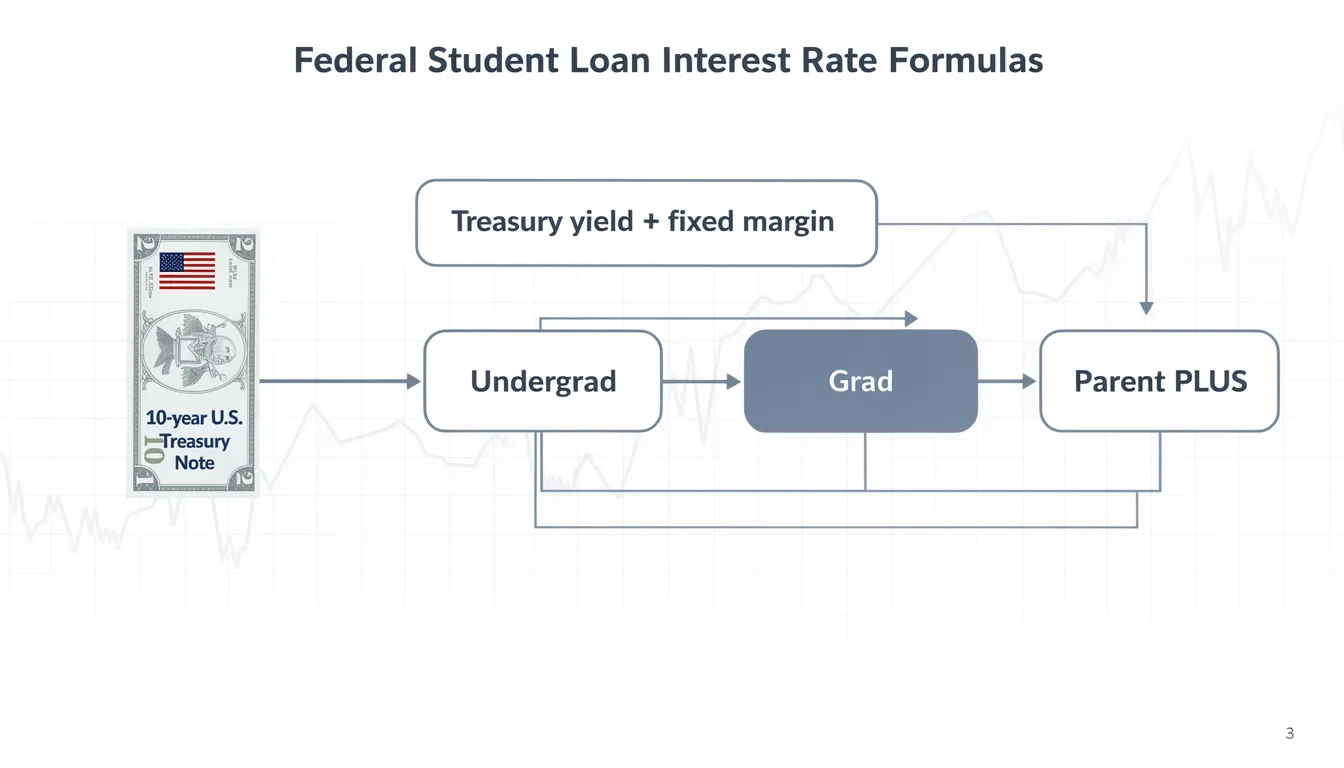
Federal student loan rates aren't negotiated by Congress each year — they follow a formula Congress established in the Bipartisan Student Loan Certainty Act of 2013. The formula takes the high yield on the 10-year U.S. Treasury Note from the final auction before June 1, then adds a fixed spread that varies by loan type:
- Undergraduate Direct Loans: Treasury yield + 2.05%
- Graduate Unsubsidized Loans: Treasury yield + 3.60%
- PLUS Loans (Parent or Grad): Treasury yield + 4.60%
There are statutory rate caps too: 8.25% for undergraduate loans, 9.50% for graduate unsubsidized, and 10.50% for PLUS loans. We're not near those ceilings yet. But rates have climbed from as low as 2.75% in 2020-21, which shows how much this formula can swing when Treasury markets run hot.
The 2026-27 Federal Rate Breakdown
Here's where every loan type lands for disbursements on or after July 1, 2026:
| Loan Type | 2025-26 Rate | 2026-27 Rate | Change |
|---|---|---|---|
| Direct Subsidized (Undergrad) | 6.39% | 6.52% | +0.13% |
| Direct Unsubsidized (Undergrad) | 6.39% | 6.52% | +0.13% |
| Direct Unsubsidized (Graduate) | 7.94% | 8.07% | +0.13% |
| Direct PLUS (Parent & Grad) | 8.94% | 9.07% | +0.13% |
Every category moved by exactly 0.13 percentage points because the Treasury yield moved by the same amount for all borrowers.
What matters more than the year-over-year change is that these rates are fixed for the life of each loan. A borrower who took out loans in 2020-21 at 2.75% still carries that rate today. A borrower starting in fall 2026 will carry 6.52% until their last payment. The fixed-rate structure is genuinely valuable protection against future rate volatility.
On a $27,000 loan (close to the average federal undergraduate balance) at 6.52% over 10 years, total interest costs approximately $9,847. At last year's 6.39%, that same loan would have cost around $9,637. That 0.13-percentage-point increase costs you $210 over the life of the loan. Not catastrophic, but not free.
The Hidden Cost: Origination Fees
Interest rates grab the headlines, but origination fees are a real cost that most comparison articles skip entirely. Federal loans charge them. Private loans generally don't.
For 2026, federal origination fees are:
- Direct Subsidized and Unsubsidized Loans: 1.057%
- Direct PLUS Loans: 4.228%
The fee is deducted before you see the money. Borrow $10,000 in subsidized loans and you receive $9,894.30 — but you owe the full $10,000 plus interest. For PLUS loans, the math is more sobering: a $20,000 Parent PLUS loan means $845.60 comes off the top before a single dollar reaches the school account.
When you factor in the 9.07% interest rate and the 4.228% origination fee on PLUS loans, the true borrowing cost runs meaningfully higher than the headline rate suggests. Private lenders almost universally charge zero origination fees, which is a real competitive advantage for qualified borrowers.
Private Loan Rates in 2026: A Very Wide Range
Private student loan rates have a feature that makes comparison genuinely difficult: the spread between the best and worst rates is enormous. Here's the current landscape for undergraduate borrowers from major lenders (as of mid-2026):
| Lender | Fixed APR Range | Variable APR Range |
|---|---|---|
| Sallie Mae | 2.89% – 17.49% | 3.75% – 16.37% |
| SoFi | 2.98% – 15.99% | 4.39% – 15.99% |
| Earnest | 3.14% – 16.74% | 5.24% – 17.10% |
Those low floors — 2.89%, 2.98%, 3.14% — look appealing. But the deck is stacked against the average 18-year-old applying solo. Those rates go to borrowers (or cosigners) with strong credit scores, often 750+, stable income, and short repayment terms. Most undergraduates have none of that.
The median private student loan borrower isn't getting 3%. They're landing somewhere in the 8%-12% range, depending on creditworthiness and term. That's where private lending quietly costs more than federal, despite what the advertising suggests.
The question isn't what rate the brochure shows. It's what rate you'll actually qualify for — and what protections you give up in the process.
Private loans don't come with federal income-driven repayment plans, Public Service Loan Forgiveness, or the ability to pause payments during genuine hardship. Those features have real dollar value that a simple rate comparison misses.
Federal vs. Private: How to Decide
This doesn't have to be a coin flip. There's a reasonably clear framework for who should use what.
Start with federal loans in almost every situation. They offer fixed rates with no credit check required for undergraduate borrowers, income-driven repayment plans that cap monthly payments at a percentage of discretionary income, and access to forgiveness programs. For most borrowers, these protections are worth more than a marginally lower headline rate from a private lender.
Private loans make sense in specific situations:
- You've hit federal borrowing limits (the dependent undergraduate lifetime cap is $31,000; graduate limits are higher but still finite)
- You or your cosigner has strong enough credit to reliably land below 6.52% on a fixed-rate private loan
- You're entering a high-income field where income-driven repayment and forgiveness aren't relevant to your plan
- You're comparing a 5% private rate to a 9.07% PLUS loan — for many families, that math clearly favors the private option
Graduate students face a harder call. An 8.07% federal graduate rate against Sallie Mae's floor of 2.89% looks extreme on paper, but most graduate borrowers still get IDR and PSLF protections with federal loans that don't exist in the private market. Run the full numbers on both paths before committing.
Subsidized vs. Unsubsidized: A Difference That Costs Real Money
Both loan types carry the same 6.52% rate for undergraduates in 2026-27, but they're not the same product.
Subsidized loans are the better deal because the federal government covers the interest while you're in school at least half-time, during your grace period, and during deferment. With unsubsidized loans, interest accrues from day one. If you don't pay it while in school, it capitalizes when repayment begins.
On a $3,500 unsubsidized loan over a 4-year degree at 6.52%, approximately $931 in interest accumulates before your first payment hits. A subsidized loan for the same amount starts repayment at $3,500. That's $931 in capitalized interest before you've made a single payment — a meaningful head start in the wrong direction.
Subsidized loans are available only to undergraduates with demonstrated financial need. If you qualify, max them out before touching unsubsidized loans. Every dollar.
Should You Refinance Existing Loans?
Refinancing replaces existing loans with a new private loan at a new rate. The pitch is simple: if you're paying 8% on a grad loan from 2023 and can qualify for 5% today, the savings are real.
Current refinance rates from major lenders (mid-2026):
- SoFi: Fixed 4.15%-10.24%, Variable 6.13%-10.24%
- Earnest: Fixed 4.99%-9.99%, Variable 5.89%-9.99%
According to the Education Data Initiative, the average refinanced student loan balance sits around $57,489. Moving from 7% to 5% on that balance over 10 years saves roughly $6,847 in total interest. That's real money.
But refinancing federal loans into a private loan is a permanent, irreversible trade. Income-driven repayment eligibility disappears. PSLF eligibility disappears. Federal forbearance protections disappear. If there's any chance you'll pursue forgiveness or if your income might fluctuate, the math rarely works out in your favor.
Refinancing makes the most sense when your loans are already private, your income is high and stable, and forgiveness is definitively off the table.
Bottom Line
The 2026-27 rate increases are modest, but federal borrowing costs have held near their highest levels since 2008-09 for two years running. Here's what to do with this information:
- Max out subsidized loans first — the government covering in-school interest saves you approximately $931 per $3,500 borrowed over four years
- Get an actual rate quote from private lenders before concluding they're cheaper — a pre-qualification (soft pull, no credit score impact) from SoFi or Earnest tells you what you'd really pay, not what an ad shows
- Don't refinance federal loans unless forgiveness is definitively off the table and your income is stable and high
- Run the full PLUS loan math — 9.07% interest plus a 4.228% origination fee is expensive; compare private parent loan options if your credit qualifies
- Watch next May's Treasury auction — if the 10-year yield climbs past 4.75%, the 2027-28 undergraduate rate would clear 6.80%, and the PLUS rate would push toward 9.35%
The undergraduate rate cap is 8.25%. We're at 6.52% today. Nothing in the current Treasury environment signals a return to pandemic-era lows, so borrowing thoughtfully now beats waiting for a rate drop that may not come.
Frequently Asked Questions
Why do federal student loan rates change every year?
Federal rates reset annually based on the high yield of the 10-year U.S. Treasury Note from the final auction before June 1. The May 12, 2026 auction produced a yield of 4.468%, which mechanically set the 2026-27 rates. Congress established this formula in 2013, so the Education Department has no authority to override what the bond market produces.
Can I qualify for a private student loan rate lower than 6.52% as an undergraduate?
Technically yes — lenders advertise floors as low as 2.89%. But qualifying typically requires a cosigner with a 750+ credit score and stable income. Most undergraduates don't hit that bar on their own. Submit a pre-qualification application before assuming you'll get a competitive rate — it's a soft credit pull that won't affect your score, and it tells you what you'd actually be offered.
Myth vs. reality: Are variable-rate private loans always cheaper than federal fixed rates?
Variable rates can start lower — some lenders show rates below 4% today. But they move with the market. If Treasury yields climb 1.5 percentage points over three years, your "cheap" variable loan could be costing you 7%+ while a federal fixed loan stays locked. For most borrowers, the certainty of a federal fixed rate is worth more than chasing a variable floor that may not last.
Should graduate students consider private loans over federal unsubsidized loans?
Potentially, for borrowers in high-income fields with strong credit and no interest in loan forgiveness. At 8.07%, the 2026-27 graduate federal rate is genuinely high compared to what a creditworthy borrower might access privately. But income-driven repayment and PSLF eligibility have real monetary value that doesn't appear in a rate comparison table. Calculate the full scenario before deciding.
What's the difference between federal loan consolidation and refinancing?
Federal consolidation combines multiple federal loans into one Direct Consolidation Loan at a weighted average of your existing rates, rounded up to the nearest one-eighth of one percent. You keep federal protections but rarely save money on interest. Private refinancing offers a new rate — potentially lower — but you permanently lose all federal protections. They sound similar but serve very different purposes.
Are Parent PLUS loans worth it at 9.07% plus a 4.228% origination fee?
They're the priciest standard federal borrowing option, and families with good credit should get private loan quotes before committing. A parent with a 760 credit score might qualify for a private loan in the 5%-6% range, which could save thousands over a 10-15 year repayment. Unlike student federal loans, Parent PLUS loans don't qualify for income-driven repayment plans that could meaningfully shrink monthly obligations.
Sources
- Interest Rates for Federal Direct Loans First Disbursed July 1, 2026 — FSA Partners
- Federal Student Loan Interest Rates Set To Rise Slightly For 2026-2027 — The College Investor
- Federal Student Loan Interest Rates Are Going Up for 2026-27 — Money.com
- Average Student Loan Interest Rate (2026): Federal vs Private — Education Data Initiative
- Best Private Student Loans & Interest Rates in June 2026 — Credible
- Earnest vs. Sallie Mae: Which Student Loan Lender Is Better in 2026? — LendEdu
- Best Refinance Student Loans In 2026 — Bankrate
- Historical Federal Student Loan Interest Rates — The College Investor