Lead levels in California schools’ drinking water
Lead testing in California public K-12 schools hasn’t been required for the past five years. The state program ended July 1, 2019, but we updated our map to include data from several districts* that conducted their own water testing after 2020. We also added active lead levels at school sites, based on available records, along with the number of fixtures tested across different lead ranges. Data is updated as of June 27, 2024.
.errordiv { padding:10px; margin:10px; border: 1px solid #555555;color: #000000;background-color: #f8f8f8; width:500px; }#advanced_iframe_37 {visibility:visible;opacity:1;vertical-align:top;}.ai-info-bottom-iframe { position: fixed; z-index: 10000; bottom:0; left: 0; margin: 0px; text-align: center; width: 100%; background-color: #ff9999; padding-left: 5px;padding-bottom: 5px; border-top: 1px solid #aaa } a.ai-bold {font-weight: bold;}#ai-layer-div-advanced_iframe_37 p {height:100%;margin:0;padding:0}var ai_iframe_width_advanced_iframe_37 = 0;var ai_iframe_height_advanced_iframe_37 = 0;function aiReceiveMessageadvanced_iframe_37(event) { aiProcessMessage(event,”advanced_iframe_37″, “true”);}if (window.addEventListener) { window.addEventListener(“message”, aiReceiveMessageadvanced_iframe_37);} else if (el.attachEvent) { el.attachEvent(“message”, aiReceiveMessageadvanced_iframe_37);}var aiOnloadScrollTop=”true”;var aiShowDebug=false;
if (typeof aiReadyCallbacks === ‘undefined’) {
var aiReadyCallbacks = [];
} else if (!(aiReadyCallbacks instanceof Array)) {
var aiReadyCallbacks = [];
} function aiShowIframeId(id_iframe) { jQuery(“#”+id_iframe).css(“visibility”, “visible”); } function aiResizeIframeHeight(height) { aiResizeIframeHeight(height,advanced_iframe_37); } function aiResizeIframeHeightId(height,width,id) {aiResizeIframeHeightById(id,height);}var ifrm_advanced_iframe_37 = document.getElementById(“advanced_iframe_37”);var hiddenTabsDoneadvanced_iframe_37 = false;
function resizeCallbackadvanced_iframe_37() {}
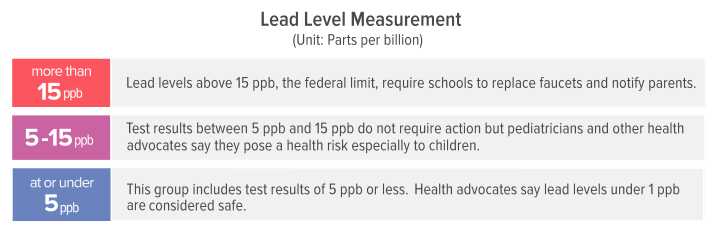
State law requires action only when lead exceeds 15 parts per billion (ppb), but many schools with 5 to 15 ppb have no follow-up plans, even though experts say those levels can still harm children.
*Data collected from the California State Water Resources Control Board (from Jan. 1, 2017 to Sept. 24, 2020) and several districts that conducted their own water testing after 2020, including San Bruno Park Elementary in San Mateo (from Oct. 28, 2022 to July 21, 2023), La Mesa-Spring Valley in San Diego (from Sept. 12, 2023 to Oct. 17, 2023),Castro Valley Unified in Alameda (from Nov. 13-17, 2023), Encinitas Union Elementary in San Diego (from April 12-26, 2023),Oakland Unified in Alameda (from March 2022 to September 2024), San Francisco Unified (from May 7, 2022 to Nov. 11, 2023).
Note: Some of the data records may not be updated regularly on school district websites. To confirm results of lead testing, please contact your local school directly.