How to Use Employer Tuition Reimbursement Programs (And Actually Get Paid)
Somewhere in your benefits portal, there's probably a line item that says something like "Educational Assistance" or "Tuition Reimbursement." And if you're like most people, you've skimmed past it a dozen times. Here's the thing: 92% of U.S. organizations offer some form of education benefit, yet only 2% of eligible employees ever use it. That's tens of thousands of dollars sitting on the table — unclaimed, year after year.
This guide cuts through the HR-speak and shows you exactly how to claim it.
Two Different Programs, One Confusing Name
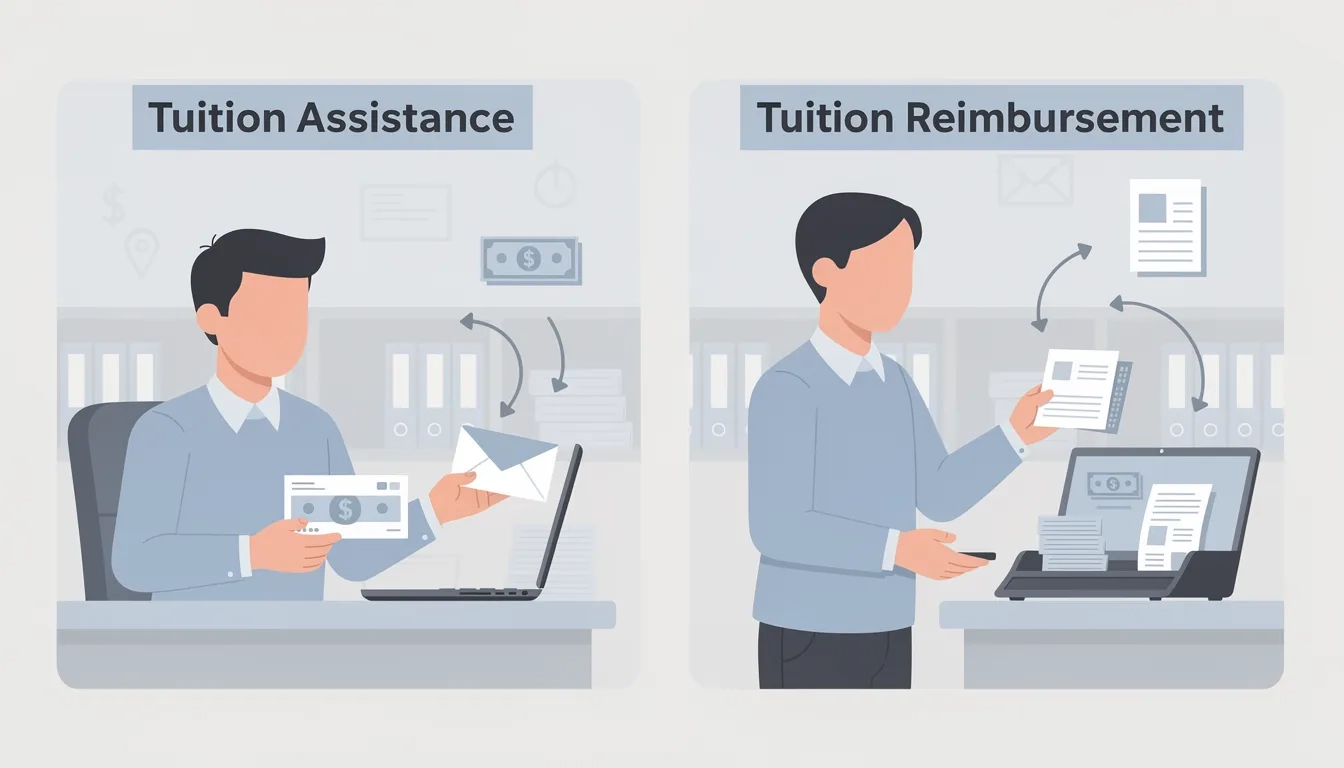
Before anything else, understand that "tuition reimbursement" and "tuition assistance" get used interchangeably, but they describe two very different payment structures.
Direct payment programs (sometimes called tuition assistance) have your employer pay the school directly before classes start. Amazon's Career Choice program works this way. So does Starbucks's College Achievement Plan. You never touch the money, which means no cash flow headache.
Reimbursement programs flip the order. You pay tuition upfront, complete the course, submit documentation, and then wait 30–60 days for a check. This is the more common model at mid-size and large employers. The catch: you may need to float $2,000–$5,000 out of pocket while you wait.
Knowing which model your employer uses changes how you plan. If your company reimburses after completion, you'll want to factor in whether you can cover the cost while you wait — especially for a multi-course program.
The $5,250 Tax Rule (And Why It Matters More Than the Dollar Amount)
The number you'll see everywhere is $5,250 per year. That's the IRS limit under Section 127 of the tax code for employer-provided educational assistance that you receive completely tax-free. Your employer deducts it, you don't pay income tax on it.
Under IRC Section 127, up to $5,250 in employer-paid educational assistance is excluded from an employee's gross income each calendar year — for undergraduate courses, graduate courses, or even non-work-related classes.
What trips people up is what happens above that threshold. Anything your employer pays beyond $5,250 gets reported as ordinary wages on your W-2. You owe income tax and payroll taxes on it. That's not necessarily a dealbreaker (getting $8,000 in tuition paid and owing taxes on $2,750 is still a good deal), but you need to know about it in advance.
The $5,250 limit has been frozen since 1986, which is genuinely remarkable. Starting with tax year 2027, the IRS will begin indexing it for inflation — but for 2026, it stays at $5,250.
What the benefit covers:
- Tuition and fees
- Books, supplies, and required equipment
- Undergraduate and graduate courses
- Classes that have nothing to do with your current job (yes, really)
What it does not cover:
- Meals, lodging, or commuting costs
- Laptops or tools you keep after the course ends
- Your spouse's or dependent's education loans
How to Actually Apply (Don't Skip Step 3)
Most employees who try to use this benefit and fail do so because they enrolled in a program first and asked for approval second. HR departments are not obligated to reimburse expenses you incurred before they signed off.
Here's the process that actually works:
- Pull up your benefits documentation. Look in your employee handbook or benefits portal. Find the specific written educational assistance plan — it must be a formal written plan to qualify as tax-free under IRS rules.
- Check eligibility requirements. Most programs require 90 days to one year of service before you qualify. Some require full-time status. Note the minimum grade requirement (typically a B or C+).
- Get pre-approval from HR before you enroll. This is the step people skip. Submit your course or program for review before you register or pay anything.
- Confirm the school is approved. Most employers require regional or national accreditation. Some have a specific list of partner schools. Going off-list can cost you the reimbursement entirely.
- Keep every receipt and grade record. When reimbursement time comes, you'll need proof of payment and proof you passed.
- Submit your reimbursement claim within the deadline. Some companies have a 60-day window after course completion. Miss it and you may be out of luck for that semester.
The pre-approval step (step 3) is the one that bites people most often. Think of it like getting a medical procedure pre-authorized by your insurance — the care you already received doesn't become covered retroactively.
Clawback Clauses: The Fine Print That Can Cost You Thousands
If your employer pays for your MBA and you leave two months later, they want their money back. That's the logic behind clawback clauses, also called repayment agreements or service commitments.
Most programs require you to stay employed for 12–24 months after completing your coursework or receiving reimbursement. The structure varies:
| Departure Timing | Typical Repayment |
|---|---|
| Within 6 months | 100% of reimbursed amount |
| 6–12 months | 75% |
| 12–18 months | 50% |
| 18–24 months | 25% |
| After 24 months | $0 |
The sliding scale is the most common approach, and it's reasonably fair. What's less fair — and increasingly contested — is enforcing these clauses when the employee didn't choose to leave.
California passed AB 692 in 2025, restricting employers from enforcing certain clawback and "stay-or-pay" arrangements, particularly where the separation was involuntary. If you're laid off or your position is eliminated, the argument that you owe back full tuition is on shakier legal ground than it used to be.
Before you sign a reimbursement agreement, read it carefully. Ask specifically: what happens if I'm laid off? What happens if I'm transferred to a role where the degree is irrelevant?
How to Squeeze More Value Out of the Benefit
The $5,250 annual cap sounds modest — one three-credit graduate course at a private university can easily run $4,500 to $6,000. But there are real ways to stretch this.
Stack it with other financial aid. Your employer's $5,250 payment doesn't automatically disqualify you from federal grants or scholarships. It affects your Expected Family Contribution on the FAFSA, but strategic planning can still leave room for Pell Grants or institution-specific aid. Talk to your school's financial aid office about how to coordinate the two.
Time your enrollment to the calendar year. The benefit resets January 1. If you're approaching your annual cap in October, consider whether your next course can start in January rather than the fall semester. That way you get a full $5,250 for that course rather than none.
Choose programs with employer partnerships. Several large employers have negotiated reduced or eliminated tuition rates with specific schools. Starbucks's deal with Arizona State University's online program means eligible baristas get a full bachelor's degree covered. Amazon's Career Choice program covers up to 95% of tuition for in-demand certifications. These partner programs often eliminate the cash flow problem of reimbursement models entirely.
Document the business connection. Even if your plan covers non-work-related courses, framing your studies as career development when you talk to your manager tends to generate more goodwill — and more flexibility if scheduling conflicts arise.
Notable Programs Worth Benchmarking
If you're evaluating a job offer or wondering how your company stacks up, here's a quick look at programs that consistently rank among the most generous:
| Company | Annual Benefit | Key Details |
|---|---|---|
| Starbucks | 100% tuition | ASU Online only; eligible after 90 days |
| Boeing | 100% for STEM | 300+ approved schools |
| Ford | $6,000/year | Full-time employees only |
| Amazon Career Choice | Up to 95% / $5,250 | High-demand fields; 90-day wait |
| Target | $5,250/year | Undergraduate degrees |
| GEICO | $5,250/year | Accredited 2- or 4-year colleges |
Starbucks's program deserves a closer look because it's a genuine outlier. A part-time barista working 20 hours a week qualifies for full coverage of an ASU Online degree. The constraint is the school: it's Arizona State or nothing. For some people that's fine; for others, it's a dealbreaker. Pick your degree program based on what's actually good for your career, not just what your employer will pay for.
The Hidden Cost That Nobody Mentions
Taking classes while working full-time is hard. Not "busy" hard — genuinely difficult. A typical graduate course requires 8–12 hours of work per week outside of class. If you're managing a team, raising kids, or working irregular shifts, that time has to come from somewhere.
The employees who get the most out of these programs are deliberate about it: they pick online programs that allow asynchronous learning, they tell their managers upfront (scheduling flexibility matters), and they don't try to take three courses a semester while working full-time.
One course per semester is a sustainable pace for most working adults. Over three years, that adds up to a graduate certificate or a significant portion of a degree — fully funded.
The opportunity cost argument is worth making here too. A $5,250 annual benefit, taken consistently over four years, represents $21,000 in tax-free education funding. At a 28% combined marginal tax rate, that's the equivalent of $29,167 in gross income. Most people don't think of it that way, but you should.
Bottom Line
- Get pre-approval before you spend a dollar. This is the single rule that prevents the most painful outcomes.
- Read your clawback clause before you sign. Understand exactly what you owe if you leave, and ask what happens in an involuntary separation.
- Stack the $5,250 with other aid where possible, and time enrollment to reset the annual cap in your favor.
- One course per semester beats burnout. The benefit renews every year — you don't have to rush.
- If you haven't opened your company's educational assistance policy yet, open it today. The writing has been on the wall for years: this is one of the most underused, most valuable benefits in the American workforce.
Frequently Asked Questions
Does employer tuition reimbursement affect my financial aid eligibility?
Yes, but not as severely as most people assume. Employer educational assistance counts as a resource on your FAFSA and can reduce your need-based aid eligibility dollar-for-dollar. However, Pell Grants and merit-based scholarships are typically unaffected. Talk to your school's financial aid office before assuming you can't qualify for both.
Can I use employer tuition reimbursement for any degree, or does it have to be job-related?
Under IRS Section 127, your employer's written educational assistance plan can cover courses that have nothing to do with your current job — and still be tax-free up to $5,250. The catch is that your employer's internal policy may be more restrictive than IRS rules. Some companies limit coverage to degrees relevant to your field. Check your specific plan, not just the IRS rules.
What happens to unused tuition reimbursement at the end of the year?
It disappears. The IRS does not allow unused portions of the $5,250 annual limit to carry over to the following year. If you qualify for $5,250 and only use $3,000, the remaining $2,250 is gone. This is a strong argument for planning your coursework around the calendar year rather than whenever it's convenient.
My employer reimbursed more than $5,250 — do I owe taxes on the difference?
Yes. Any amount above $5,250 is treated as ordinary wages. Your employer should report it on your W-2, and you'll owe federal income tax and payroll taxes on that portion. The effective cost depends on your tax bracket, but receiving $8,000 in tuition coverage and paying taxes on $2,750 is still a significant net benefit for most employees.
What's the difference between tuition reimbursement and the Lifetime Learning Credit?
They can't both apply to the same expenses. If your employer paid $5,000 of tax-free tuition, you can't also claim the Lifetime Learning Credit on that same $5,000. The IRS calls this "double-dipping." If you paid additional tuition out of pocket beyond what your employer covered, you may be able to claim credits on that remaining amount.
Can my employer help pay off my student loans through this benefit?
Through December 31, 2025, employers could use the same Section 127 educational assistance program to make tax-free payments toward employees' existing student loans, up to the same $5,250 annual cap. That provision has since expired unless Congress extends it. Check current IRS guidance or consult a tax professional if you're exploring this option.
Sources
- IRS FAQs on Educational Assistance Programs
- IRS: Employer-Offered Educational Assistance Programs Can Help Pay for College
- Employer Tuition Assistance Guide 2026 | MarketingCollege.org
- California AB 692 and Tuition Reimbursement Clawback Policies | SkillsWave
- Amazon, Disney, Starbucks and companies that help pay for college | Quartz
- What Is Employer Tuition Reimbursement? | Northeastern Online