How to Build a Class Schedule That Won't Wreck You by Midterms
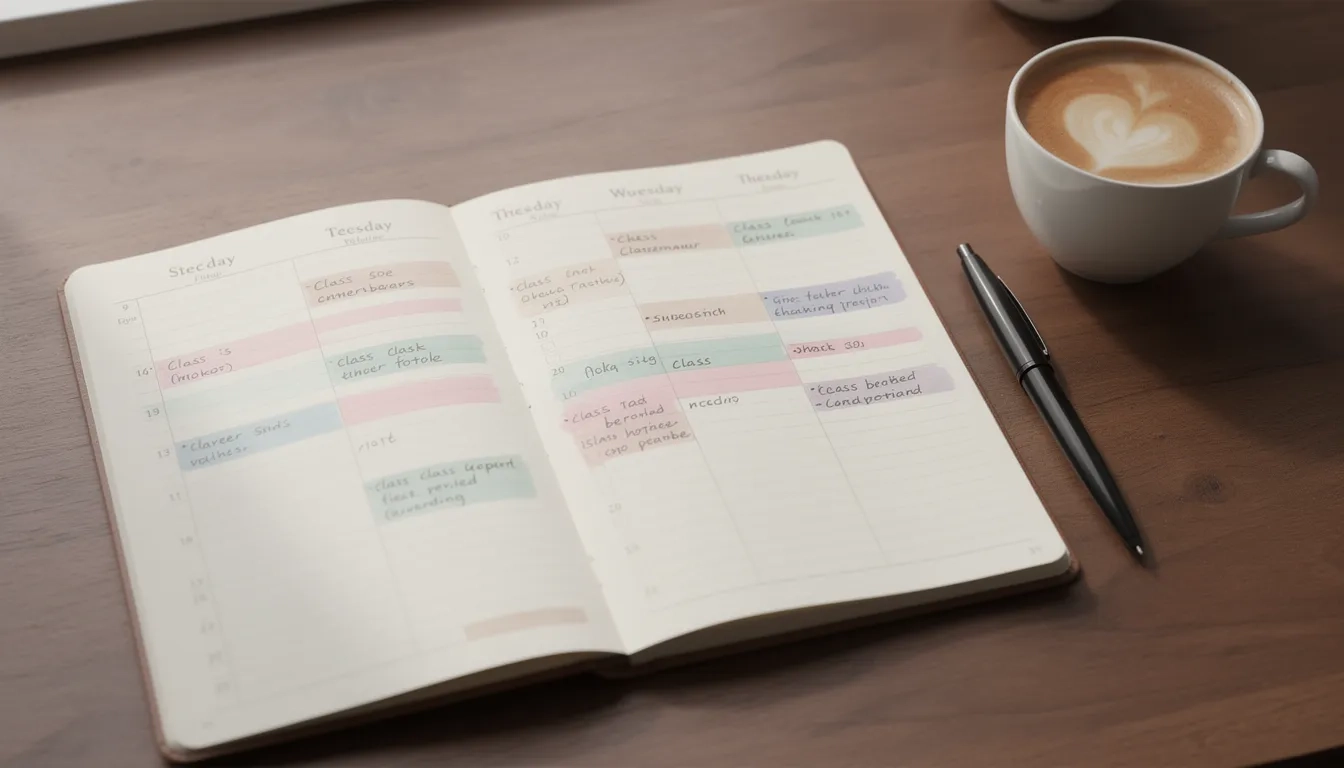
Every August, somebody builds a schedule that looks completely reasonable on paper. Fifteen credits, four classes, nothing before 10am. By week nine they're crying in a library bathroom over a discussion post worth 2 percent of their grade. The credits added up fine. The schedule itself was the problem.
Most advice about avoiding burnout is really about willpower — sleep more, meditate, say no to plans. Useful, sure, but it skips the thing you actually control before the semester even starts: the shape of the schedule itself. Get that shape wrong and no amount of discipline saves you.
Why Total Credit Hours Is the Wrong Metric
Registrars measure your load in credit hours. Your nervous system measures it in something else entirely — call it workload density, the amount of cognitive and emotional effort packed into a given week, regardless of what the course catalog says.
A 2022 study published in the journal Internet and Higher Education looked at this directly, using learning-management-system records instead of self-reports. Researchers found that credit hours barely predicted how heavy students actually perceived a course to be. What predicted it: number of assignments, and how often students dropped off late in the term. Workload, the authors argued, is a mix of time, mental effort, and psychological stress — and credit hours only capture the first one.
Here's the misconception that trips people up: fewer credits doesn't automatically mean less stress. Twelve credits made up of three writing-intensive seminars, each with weekly drafts and a professor who leaves margin comments in red pen, will flatten you faster than sixteen credits split between two easy gen-eds, one moderate lab, and one genuinely hard course.
- A 15-credit semester of five breezy electives: low density, low risk
- A 12-credit semester of three proof-heavy STEM courses: low credit count, brutal density
- A 16-credit semester mixing two easy, one moderate, one hard: manageable density despite the higher number
Before you register, ask each course what it actually demands weekly — not what it's worth on paper. Reading load, assignment frequency, and how forgiving late work policies are all matter more than the credit number sitting next to the course title.
Balancing Difficulty Levels Across the Semester
Here's the part almost nobody plans for on purpose: mixing difficulty levels matters more than the total number of hard courses you take in a year. It's not about avoiding hard classes. It's about never stacking them in the same sixteen weeks.
Anchor with one heavy course, not three
Pick a semester's single hardest class — the one requiring real sustained focus, like organic chemistry or a proof-based math sequence — and build everything else around it as lighter counterweight. One anchor course, three supporting ones. Not four anchors fighting for the same mental bandwidth.
Rotate your intensive electives
Writing seminars, studio art, project-based engineering courses — these eat time unevenly, in bursts around deadlines rather than steady weekly chunks. Taking two in the same term means their crunch weeks will very likely collide, because most professors schedule major deliverables around the same points in the semester (midterms, pre-finals).
A common trap: students "front-load" the hard stuff to get it over with, or push it all to senior year to enjoy easier terms early on. Both backfire. Front-loading risks burnout before you've built academic stamina; back-loading stacks your hardest courses right when job applications, capstones, and grad school anxiety pile on too.
Spacing Classes to Protect Study and Recovery Time
A schedule with zero gaps looks efficient. It isn't. Gaps between classes aren't dead time — they're where review, recovery, and actual learning happen, and cutting them out to "get done early" tends to backfire by week six.
Research on the spacing effect is about as settled as psychology gets: material learned in spaced sessions sticks dramatically better than material crammed together, because your brain needs downtime to consolidate it. Yet students routinely ignore this in their own behavior. One study tracking real usage found that among students who engaged with course materials over a ten-day window, 82.8 percent did all their reading in just three of those days. We know spacing works. We schedule like we don't believe it.
There's scheduling-format evidence too. A study by researchers Michael Gallo and Michael Odu, published examining college algebra sections, found that students in classes meeting once a week scored consistently lower on unit tests and finals than students in sections meeting three times a week — even with identical total contact hours. Compressed exposure to hard material seems to hurt performance, not just comfort.
Gaps aren't the enemy of a tight schedule. They're the maintenance windows that keep the whole thing running.
Practically: leave at least one buffer block between a genuinely hard class and whatever comes next, especially if that next thing also demands focus. Back-to-back Organic Chem and Calc III with no break in between is asking your brain to sprint two marathons with no water stop.
Avoiding the Everything-Due-the-Same-Week Trap
This is the one nobody checks before they register, and it's completely avoidable. Every professor writes a syllabus assuming their class is the only one you're taking. Nobody coordinates midterm weeks across departments. So it falls on you.
Read every syllabus before add/drop closes
Most schools give you a week or two to review full syllabi and swap sections. Use it. Pull up the exam schedule, project due dates, and paper deadlines from every class you're considering, and lay them side by side on one calendar.
What to flag as a collision risk
- Two or more major exams in the same calendar week (common during "midterm season," roughly weeks 6-8)
- A big project due the same week as finals prep starts
- Multiple courses with no-drop, no-late-work policies clustering deadlines near breaks
- A single week with three or more graded deliverables across different classes
One deadline in isolation is fine. Three in the same week — a midterm, a lab report, and a paper draft — is a different animal entirely, and it's the kind of week that turns a good semester sideways. Catching that pattern in week one, when you can still swap a section, beats discovering it in week seven when you can't.
Building in Intentional Buffer Time
Buffer time gets treated like a luxury, something you add if the schedule happens to have room left. Flip that. Build the buffer first, then fit classes around it.
The advice from student-success offices tends to converge on something concrete: keep at least one four-hour block of genuinely free time per week, non-negotiable, protected from classes, work shifts, and "quick" commitments. Not for catching up on assignments — for nothing in particular.
That's the part people get backwards. Buffer time isn't insurance against falling behind; it's what keeps the rest of the week from feeling like a countdown. Knowing Thursday afternoon is untouchable changes how Tuesday and Wednesday feel, even before Thursday arrives. It's a small trick, but it works because anticipatory stress is doing a lot of the damage, not just the workload itself.
A few ways to protect it in practice:
- Block it on your calendar before you register for classes, like it's a class itself
- Treat it as immovable — don't let one bad week cannibalize it "just this once"
- Keep it at the same time each week so it becomes a habit, not a negotiation
When to Talk to an Advisor About Pacing
Advisors see something you can't: pattern data across thousands of students who've taken the exact combination of courses you're considering. That's worth more than it sounds like on a random Tuesday when you're just trying to fit chemistry lab into your schedule.
Talk to one when any of these show up:
- You're already thinking about dropping a class in week three, before anything's gone visibly wrong
- Your GPA looks fine but you're missing sleep, meals, or plans to keep up
- You're not sure whether two required courses have a reputation for colliding on deadlines
- You're trying to decide whether to front-load or spread out a difficult major sequence
One thing advisors will tell you that students rarely believe until they hear it directly: dropping a class before your school's deadline usually doesn't touch your GPA at all. Staying in a class that's actively burning you out to "not give up" is often the worse move, not the tougher one. Pride is not a scheduling strategy.
| Burnout-Prone Schedule | Burnout-Resistant Schedule |
|---|---|
| Back-to-back classes, no gaps | Buffer block between demanding classes |
| All hard/dense courses in one term | Mixed difficulty: one anchor, lighter supports |
| Every class packed into mornings | Spread across the day, energy-matched |
| Deadlines discovered mid-semester | Syllabi cross-checked in week one |
| Zero protected free time | One 4-hour non-negotiable block weekly |
| Intensive electives doubled up | Intensive electives rotated across terms |
Bottom Line
- Stop scheduling by credit hours alone. Check assignment frequency, reading load, and deadline clustering before you register.
- Pick one anchor course per semester and build lighter classes around it — never stack two or three heavy ones together.
- Leave real gaps between demanding classes. They're recovery time, not wasted time.
- Read every syllabus during add/drop and map deadlines onto one calendar before you're locked in.
- Protect one buffer block a week like it's a class, and loop in your advisor the moment pacing feels off, not after week ten.
Frequently Asked Questions
Does taking fewer credits always reduce burnout risk?
No, and this is the most common mistake in schedule planning. Twelve credits of three writing-intensive or proof-heavy courses can produce far more strain than sixteen credits mixing easy, moderate, and one hard course. Workload density, not credit count, drives the stress.
How do I actually check a syllabus before I'm locked into a class?
Most schools allow syllabus review and section changes during the first one to two weeks (add/drop period). Pull the exam dates, project deadlines, and grading policy from each syllabus and put them on one shared calendar so overlaps are visible immediately, not discovered in week seven.
Is scheduling classes back-to-back with no gaps actually bad?
Generally, yes, especially between two demanding courses. Gaps function as review and recovery windows, and research on spaced learning consistently shows better retention and performance when study and class time aren't crammed together with no breathing room.
Should I take all my hardest classes early to get them out of the way?
It's tempting, but front-loading difficulty before you've built academic stamina tends to backfire, and back-loading everything into senior year stacks your hardest courses against job or grad-school stress. Spread genuinely difficult courses across terms, one anchor course at a time.
When should I loop in my academic advisor?
As soon as you're considering dropping a class in week three, or when you can't tell whether two required courses have a habit of colliding on deadlines. Advisors have pattern data across students who've taken the same combinations you're weighing, which beats guessing.
How much buffer time should I realistically build into a week?
Aim for at least one four-hour block that's genuinely protected — not for catching up on work, just open. Treat it as immovable on your calendar, the same way you'd treat a class you can't skip.
Sources
- Credit hours is not enough: Explaining undergraduate perceptions of course workload using LMS records
- Student Burnout: A Review on Factors Contributing to Burnout Across Different Student Populations
- Examining the Relationship Between Class Scheduling and Student Achievement in College Algebra
- Do students space their course study? Those who do earn higher grades
- How to Avoid College Burnout
- Mapping Two Decades of Academic Burnout Research: Key Insights and Future Directions