Georgia FAFSA Deadline 2026: HOPE, Zell Miller & Every State Aid Program Explained
Georgia spends $1.56 billion per year on student financial aid. Most of it flows through two merit-based scholarships with no income limit whatsoever. That surprises most people. A student from a high-earning household with a 3.7 high school GPA can walk away with full tuition paid at a public university. A low-income student with a 2.8 GPA gets nothing from the state. Like it or not, that's how Georgia's system is built — and understanding it is the first step to getting every dollar you're entitled to.
When to File: Deadlines That Actually Matter
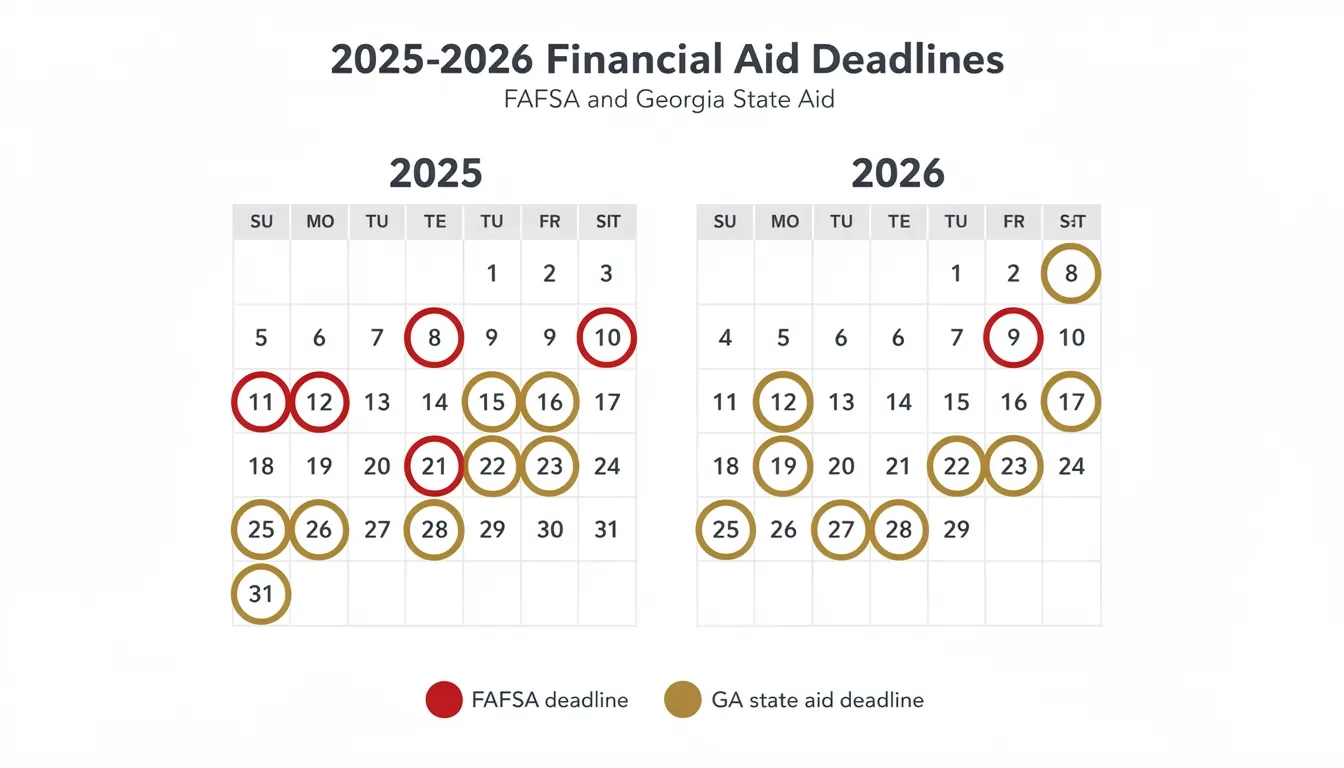
The federal FAFSA deadline for the 2025–26 academic year is June 30, 2026, at 11:59 p.m. Central Standard Time. For 2026–27, the federal cutoff shifts to June 30, 2027. These are the absolute outer limits — the last possible moment before all federal aid eligibility disappears.
Georgia's state programs work differently. There is no single fixed calendar date for HOPE or Zell Miller. According to the Georgia Student Finance Commission (GSFC), your application must be on file by the last day of your current semester — or your official withdrawal date, whichever comes first.
Here's the trap: if you're a fall semester student and haven't filed by the end of December, you forfeit that semester's award. Permanently. You cannot claim it retroactively. Students learn this the hard way every year.
Two application routes exist for Georgia state aid:
- FAFSA — covers both federal aid and Georgia state programs simultaneously
- GSFAPP (Georgia Student Finance Application) — available at gafutures.org, covers Georgia state programs only
The GSFAPP is more significant than most students realize. Students who cannot or choose not to file a FAFSA (for immigration status reasons, family financial privacy concerns, or any other reason) can still access all of Georgia's lottery-funded scholarships and grants through the GSFAPP alone. This matters for mixed-status households particularly.
The practical advice: file as early as possible after October 1 each year. There's no hard state priority deadline, but schools process aid in the order applications arrive, and later filers risk delays that push disbursements into mid-semester.
HOPE Scholarship: Georgia's Merit Backbone
The HOPE Scholarship is Georgia's signature program — merit-based, lottery-funded, and available to any Georgia resident who meets the academic bar. No income test. No family contribution calculation.
To qualify initially, you must graduate from an eligible Georgia high school with:
- A minimum 3.0 calculated HOPE GPA (more on why "calculated" matters below)
- At least four full rigor credits from Georgia's Academic Rigor Course List (which includes AP, IB, and qualifying dual enrollment courses)
For 2025–26, the award amounts scale by credit load:
| Credit Hours Enrolled | Award Amount |
|---|---|
| 15 or more | $5,017.00 |
| 12–14 hours | Prorated down |
| 7–11 hours | Prorated down |
| 1–6 hours | As low as $334.47 |
Taking 12 credits instead of 15 costs you real money. Students who drop a class late in the semester often don't realize their HOPE disbursement will shrink to match their final enrollment count.
Maintaining the scholarship requires a 3.0 cumulative HOPE GPA in college. The GSFC checks this at three checkpoints: 30, 60, and 90 attempted semester hours. Miss the mark at any checkpoint and eligibility ends at that point.
Two hard limits also apply: 127 attempted semester hours total, and a 10-year window from high school graduation (for students first disbursed Summer 2019 or later). Every course you attempt counts toward the 127 — including withdrawals, repeats, and failed classes. Students who change majors twice and retake courses frequently hit this wall in year five or six.
Zell Miller Scholarship: Full Tuition for Georgia's Top Students
The HOPE Scholarship covers a significant portion of tuition. Zell Miller covers all of it, at the standard undergraduate tuition rate for USG institutions.
To qualify initially, you need a 3.70 calculated HOPE GPA from high school, plus four rigor credits, plus a qualifying test score from a single administration: either a 1200 SAT (math and reading only) or a 25 ACT composite. Students who graduated after December 31, 2023 need that 25 ACT specifically.
One built-in exception: valedictorians and salutatorians from eligible Georgia high schools qualify automatically with just a 3.0 HOPE GPA and four rigor credits. No test score needed.
Once in college, you must maintain a 3.30 cumulative HOPE GPA at the same 30-, 60-, and 90-hour checkpoints. At major research universities like Georgia Tech or UGA, holding a 3.3 in engineering or pre-med is a real challenge. Plenty of Zell Miller recipients don't make it through sophomore year without dropping down.
Here's the useful part: if your GPA falls between 3.0 and 3.3, you automatically downgrade to HOPE rather than losing all state aid. The two scholarships function as a tier system rather than an all-or-nothing binary.
And for context on what Zell Miller is actually worth — in-state tuition at the University of Georgia runs roughly $12,080 per academic year. Full coverage over four years represents nearly $48,000. That's not nothing.
HOPE Grant and HOPE Career Grant: Technical College Path
Many Georgians overlook this completely. The HOPE Grant is a separate program from the HOPE Scholarship, designed specifically for students at Technical College System of Georgia (TCSG) schools pursuing certificates or diplomas (not bachelor's degrees).
It has a lower academic bar. There's no minimum high school GPA requirement. Georgia residents who enroll in a TCSG program and maintain satisfactory academic progress qualify. Period.
Georgia's FY2026 budget allocated a $17 million increase to the HOPE Grant — one of the larger boosts in recent years, reflecting growing enrollment in technical programs like healthcare technology, HVAC, welding, and cybersecurity.
The HOPE Career Grant stacks on top of the standard HOPE Grant for specific high-demand fields. If your TCSG program falls under healthcare, information technology, or skilled trades categories, this additional grant may cover costs beyond what HOPE Grant pays. The list of qualifying programs updates periodically, so check gafutures.org or your school's financial aid office directly.
Other Georgia State Programs Worth Knowing
Georgia Tuition Equalization Grant (GTEG): For Georgia residents attending eligible private colleges within the state. It's non-need-based, which means you don't have to demonstrate financial hardship. Georgia allocated $24 million to GTEG for FY2026. That pool is split among all eligible private-college students in Georgia, so the per-student award is modest — but it stacks with HOPE Scholarship at eligible private institutions.
REACH Georgia Scholarship: A need-based mentorship program that starts in 8th grade. Students who complete the mentorship program and meet academic benchmarks receive college scholarships. Georgia allocated $6 million in FY2026. The Georgia Budget and Policy Institute has flagged this program as underfunded relative to the state's actual need, noting that Georgia ranks third-highest nationally in student loan debt per borrower — a direct consequence of the state's heavy reliance on merit-only aid.
College Completion Grant: Targets students near the finish line who face financial barriers. $10 million total in FY2026. If you're within 30 credit hours of a degree and experiencing hardship, ask your financial aid office explicitly about this grant.
| Program | Who It's For | Need-Based? | FY2026 Funding |
|---|---|---|---|
| HOPE Scholarship | 4-year degree seekers, 3.0 GPA | No | Major increase |
| Zell Miller Scholarship | 4-year degree seekers, 3.7 GPA | No | Part of HOPE total |
| HOPE Grant | TCSG certificate/diploma students | No | +$17M increase |
| HOPE Career Grant | High-demand TCSG fields | No | Varies by program |
| GTEG | GA residents at private GA colleges | No | $24M |
| REACH Georgia | Need-based mentorship program | Yes | $6M |
| College Completion Grant | Near-graduation students | Yes | $10M |
The HOPE GPA Calculation Trap
This is where students consistently get surprised. Your high school GPA on your report card is not the same as your HOPE GPA. The GSFC recalculates it using its own methodology.
The GSFC calculation excludes courses outside the academic core and applies the rigor requirement as a separate filter. A student with a 3.3 transcript who loaded up on non-academic electives can end up below 3.0 in GSFC's system. A student sitting at a 2.95 weighted GPA who took demanding courses might clear the threshold fine.
You can check your calculated HOPE GPA before you graduate at gafutures.org. Do this by junior year. If you're borderline, there's still time to adjust your course selection.
Students from out-of-state high schools must submit transcripts manually through GSFC's Document Upload portal — the automated electronic transfer only works for Georgia high schools. Many transfer students and military families miss this step.
There's also a retroactive eligibility path. Students who graduated from non-eligible schools or unaccredited home study programs can qualify for HOPE by completing 30 semester hours at a Georgia institution with a 3.0 HOPE GPA. No high school data factors in at that point. For Zell Miller's retroactive path, you need 30 semester hours at a 3.30 HOPE GPA.
A Practical Roadmap for Georgia Students
Here's a straightforward decision tree:
TCSG certificate or diploma program? Apply for the HOPE Grant. Check HOPE Career Grant eligibility for your specific program. You're done — HOPE Scholarship requirements don't apply to you.
4-year degree at a USG or private eligible college? Check your calculated HOPE GPA at gafutures.org before applying.
- 3.0+ HOPE GPA: HOPE Scholarship
- 3.7+ HOPE GPA with 1200 SAT or 25 ACT: Zell Miller Scholarship
- Below 3.0, no test scores: Focus your energy on federal Pell Grant and school-based aid
Attending a private Georgia college? Check GTEG eligibility separately. It stacks.
From an out-of-state or non-eligible high school? Use the retroactive path: 30 hours at 3.0 HOPE GPA opens HOPE; 30 hours at 3.30 opens Zell Miller.
Within 30 hours of a degree and struggling financially? Ask your school about the College Completion Grant.
Georgia's need-based infrastructure is genuinely thin for a state its size. HOPE is a superb program for students who earned it academically — but if your household income is low and your high school GPA was average, the state offers you very little. Federal Pell Grant funding will matter far more for that profile. File the FAFSA early regardless.
The right posture for most students is to treat HOPE/Zell Miller as a bonus you've already earned, not a safety net. Because for students who miss the GPA cutoff, it isn't one.
Bottom Line
- File your FAFSA or GSFAPP as soon as possible after October 1. The Georgia state deadline is the last day of each semester, not a fixed calendar date — and there's no catching up once that term ends.
- Check your calculated HOPE GPA at gafutures.org, not just your school transcript. They can differ enough to change your eligibility.
- Zell Miller (3.7 GPA + 1200 SAT or 25 ACT) covers full tuition. HOPE (3.0 GPA) covers a portion. If you're borderline for Zell Miller and still in high school, a strong single test sitting is worth the effort.
- TCSG students have their own lane. The HOPE Grant doesn't require a high school GPA and just received one of its largest funding increases in recent history.
- If need-based aid is your primary concern, Georgia's state programs won't be your answer. The federal Pell Grant and your school's institutional aid will carry more weight.
Frequently Asked Questions
Can I get Georgia HOPE if I don't file a FAFSA?
Yes. Georgia offers the GSFAPP (Georgia Student Finance Application) at gafutures.org as an alternative to the FAFSA for accessing state-funded programs. The GSFAPP covers HOPE Scholarship, Zell Miller, HOPE Grant, GTEG, and HOPE Career Grant. You'd miss out on federal aid (Pell Grants, subsidized loans), but Georgia's lottery-funded programs are available through either application route.
Does the HOPE Scholarship have an income limit?
No. HOPE and Zell Miller are merit-based programs with no income test. Your family's financial situation has zero bearing on eligibility. This is by design — the programs were structured to reward academic achievement, funded by lottery revenue. The flip side is that students with financial need but lower GPAs receive no state scholarship support.
What happens to my HOPE Scholarship if my GPA drops below 3.0 in college?
GSFC checks your cumulative HOPE GPA at 30, 60, and 90 attempted semester hours. If you fall below 3.0 at a checkpoint, you lose HOPE eligibility at that point. You can regain it by returning to 3.0 or above at the next checkpoint. For Zell Miller, dropping below 3.30 but staying above 3.0 downgrades you to HOPE rather than eliminating all aid. Below 3.0 at any checkpoint ends Zell Miller permanently.
My HOPE GPA from GSFC is lower than my high school GPA. Why?
GSFC uses its own formula that weighs the Academic Rigor Course List and applies specific inclusion/exclusion rules to your transcript. Elective courses outside the academic core may not count. AP and IB courses are weighted in GSFC's calculation, but not all weighted courses from your school's system carry over the same way. Check gafutures.org before graduation to see your calculated HOPE GPA — not after.
Is the HOPE Grant the same as the HOPE Scholarship?
They're different programs. The HOPE Scholarship is for students pursuing associate's or bachelor's degrees at USG schools or eligible private colleges. The HOPE Grant targets students at TCSG (technical college) schools pursuing certificates or diplomas — not degree programs. The HOPE Grant has no minimum high school GPA requirement, while the Scholarship requires a 3.0 HOPE GPA from high school.
What is the deadline to keep HOPE for a specific semester?
You must have a FAFSA or GSFAPP on file by the last day of that semester (or your official withdrawal date if you leave school first). There's no single annual cutoff date. If you enroll in fall but haven't filed either application by the end of finals week, you cannot claim HOPE for that semester. File early — ideally before classes begin.
Sources
- Review Deadlines | Georgia Student Finance Commission
- Initial Academic Eligibility for the HOPE Scholarship | GSFC
- Initial Academic Eligibility for the Zell Miller Scholarship | GSFC
- HOPE & Zell Miller Scholarships | UGA Student Financial Aid
- Overview: 2026 Fiscal Year Budget for the Georgia Student Finance Commission | Georgia Budget and Policy Institute
- Georgia Tuition Equalization Grant Program | GSFC