What the Department of Education Budget Cuts Mean for Students
Something happened in the spring of 2025 that didn't get nearly enough attention: the U.S. Department of Education fired roughly half its staff in a single afternoon. About 1,315 employees were let go in March, leaving the agency with around 2,183 people — down from about 4,100. That's not a reorganization. That's a gutting.
The proposed FY2026 budget that followed made the staffing cuts look like a warmup. A $12 billion reduction — 15.3% of the department's total funding — landed alongside proposals to slash Pell Grants by nearly a quarter, eliminate TRIO programs entirely, restructure Title I for low-income schools, and consolidate 18 education programs into a block grant worth less than a third of their combined original value.
If every proposed cut goes through, millions of students are looking at a fundamentally different financial landscape. Some already are.
What the Numbers Actually Mean
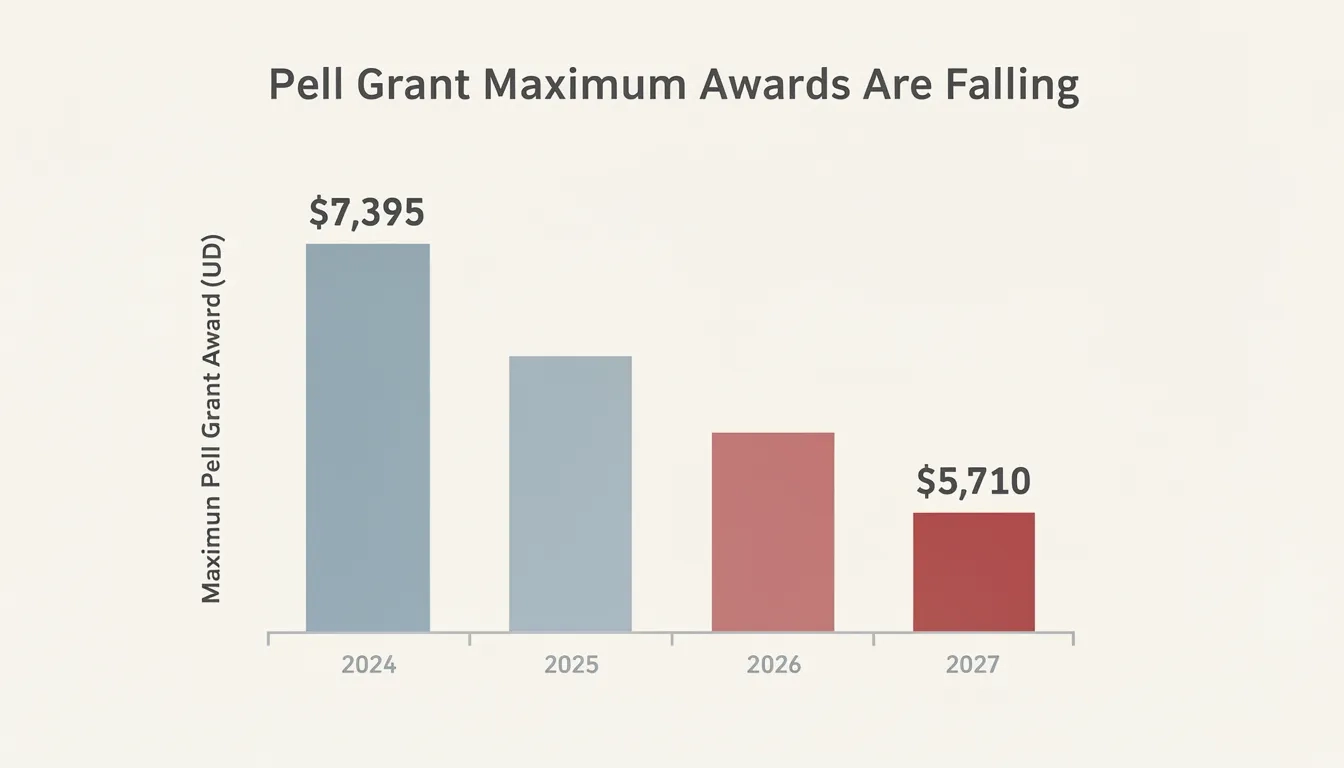
Start with the Pell Grant, because it's the bedrock of federal college aid. For the 2026-27 academic year, the White House proposed cutting the maximum award from $7,395 down to $5,710. That's $1,685 less per student per year — a 23% reduction, and the first time the maximum Pell Grant has been cut in more than 30 years.
To put that in practical terms: a full-time undergraduate already using loans to fill funding gaps would need to borrow roughly an additional $6,740 over four years just to replace what Pell used to cover. That's before accounting for room, board, or a single textbook.
TICAS President Sameer Gadkaree called the proposal "a full-scale retreat from college access and success for those who do not come from wealthy families." Hard to argue with that read.
Federal Work-Study faces a $980 million cut as well, and the federal share of student wages would drop from 75% to just 25%, meaning colleges would need to absorb most of the cost themselves. Many won't. In California alone, more than 41,000 students earned roughly $95 million in federal work-study compensation in the 2022-23 academic year. Much of that income would simply vanish.
TRIO, SEOG, and the Programs Nobody Headlines
Pell Grants get the attention. But the programs that often make the real difference between a low-income student enrolling and actually graduating are the ones getting quietly zeroed out.
TRIO is a collection of 10 federally funded programs — Upward Bound, Talent Search, Student Support Services — designed to shepherd first-generation and low-income students through the college pipeline. The budget proposes eliminating all of it. Over $1 billion gone. In California alone, that ends 450 separate projects serving more than 100,000 student participants.
Also targeted for elimination:
- GEAR UP — grants helping disadvantaged middle schoolers prepare for college years in advance
- Federal Supplemental Educational Opportunity Grants (SEOG) — campus-based grants for the neediest students; in California, roughly 252,000 students received approximately $131 million in federal SEOG money in a recent academic year
- Child Care Access Means Parents in School (CCAMPIS) — helps student parents afford childcare while enrolled
- Fund for the Improvement of Postsecondary Education (FIPSE)
These aren't fringe programs. They're the scaffolding underneath first-generation college attendance. Pull the scaffolding and the number of students who make it through doesn't just decrease — it drops unevenly, along income lines.
The FAFSA Problem Nobody Saw Coming
Here's a less-discussed angle that matters as much as the dollar cuts: the department may no longer have the operational capacity to run the programs it still funds.
When the mass layoffs hit in March 2025, officials were quick to say that FAFSA-related employees were not among those cut. But the entire vendor performance division — the team responsible for overseeing the third-party contractors who build and maintain FAFSA — was eliminated. The contractors didn't go anywhere. Companies like General Dynamics Information Technology and Accenture still hold their contracts. But nobody is watching them. The department also proposed cutting the Accenture contract (which runs student aid call centers) by 80%.
On March 13, 2025, the FAFSA website crashed and became inaccessible to students mid-application. One crash doesn't prove anything. But it showed a system under stress, with degraded human oversight, entering a period of real unpredictability.
Before the layoffs, a financial aid officer could typically help a student recover a lost Federal Student Aid ID in minutes. Now that same process can take days or weeks.
For a low-income student scrambling against enrollment deadlines, that kind of delay isn't a minor inconvenience — it's the kind of friction that causes people to give up and walk away. Eight of 21 staff members handling student loan complaints were also let go, including those managing Public Service Loan Forgiveness (PSLF) complaints and allegations of institutional fraud. The people most dependent on those complaint channels are already the most financially exposed.
K-12: A Block Grant Shell Game
The higher education cuts are stark. But K-12 schools face a different kind of problem, and it's packaged in a way that can be easy to miss.
The administration proposed consolidating 18 separate federal education programs — representing $6.5 billion in FY2024 funding — into a single "K-12 Simplified Funding Program" block grant worth $2 billion. That's a 70% funding cut dressed up as administrative efficiency.
Barbara Duffield of SchoolHouse Connection, a nonprofit focused on students experiencing homelessness, cut through the spin: "It's just another way of saying 'we're eliminating funding.'"
Programs that would disappear under this consolidation include:
- English learner support services
- Homeless student services and migrant education programs
- Afterschool and summer learning programs
- School mental health services
- Arts, technology, and emergency preparedness instruction
The House Appropriations Committee separately advanced a bill proposing a 26% cut to Title I — the main federal funding stream for schools in high-poverty areas. Title I funds reading specialists, school counselors, and instructional materials in districts that can't generate that revenue locally.
Congress did pass a continuing resolution in February 2026 that kept K-12 funding roughly flat at FY2025 levels for the current school year, so the worst proposed cuts haven't landed yet. But school districts are already drafting future budgets under genuine uncertainty, and the underlying proposals haven't gone away.
Special Education: Flat Is the New Cut
Special education funding under IDEA (Individuals with Disabilities Education Act) has mostly avoided direct cuts so far. The administration has stated publicly it intends to maintain IDEA funding at current levels.
The problem is that "current levels" is already falling short. Congress added just $23 million to IDEA funding in 2026 — a 0.15% increase — while the real costs of providing special education services have risen with wages and inflation. Flat funding in dollar terms is a real-world reduction in what schools can actually deliver.
Beyond the money, the department's staffing reductions have hollowed out oversight and enforcement capacity. Fewer civil rights investigators mean fewer resources to ensure students with disabilities are actually receiving the services they're legally guaranteed. Fewer staff in the Office of Special Education Programs means slower technical assistance and longer response times when districts file for guidance. The funding may technically be there. The infrastructure to protect how it's used is thinner than it's been in decades.
Who Gets Hit Hardest
Budget cuts don't land evenly. This round is no exception. The students most exposed to the combined set of proposed changes:
| Student Group | Primary Risk |
|---|---|
| Low-income undergrads | Pell Grant reduction, SEOG elimination |
| First-generation college students | TRIO and GEAR UP elimination |
| Students with disabilities | IDEA flat-funding, weakened enforcement |
| English learners (K-12) | Block grant consolidation, program cuts |
| Student parents | CCAMPIS elimination |
| Rural and high-poverty district students | Title I cuts, reduced federal support |
| PSLF borrowers | Fewer complaint staff, processing delays |
A 2023 Sallie Mae study found that 30% of students who leave college without a degree cite financial reasons as the primary cause. The cuts proposed here don't just make college more expensive — they reduce the support infrastructure that keeps financially fragile students enrolled past their first year. That's the part that doesn't show up cleanly in budget line items.
Bottom Line
The most accurate read of what's happening: the federal government is withdrawing from its decades-long role as a financial backstop for low-income students, and doing so on multiple fronts at once — less money per grant, fewer support programs, and less internal capacity to administer what remains. That's not a conservative interpretation; it's what the budget documents and organizational charts show.
For students and families navigating this right now:
- File your FAFSA as early as possible. Processing delays are real, the system has shown instability, and waiting until March is a risk you don't need to take.
- Identify which programs you currently use. If you receive TRIO support, work-study income, or SEOG, track appropriations news — your college's financial aid office should be updating students as things develop.
- Look at state-level aid programs. Several states have expanded their own grant programs as a hedge against federal cuts. California's Cal Grant, for example, provides a parallel funding stream independent of federal action.
- Contact your congressional representatives. K-12 districts and college access programs retain more political leverage through constituent pressure than most people assume.
- Watch the FY2026 budget timeline. The continuing resolution keeping K-12 funding flat expires, and the next appropriations cycle will determine whether proposed cuts become actual ones.
The February 2026 continuing resolution bought time. It didn't resolve anything.
Frequently Asked Questions
Are Pell Grants actually being cut right now?
The proposed 23% reduction — from $7,395 to $5,710 — was in the White House's FY2026 budget request, not yet enacted law. Congress sets the final award amounts through the appropriations process. If you're planning finances for 2026-27 enrollment, budget conservatively and don't assume the current maximum holds.
Is the Department of Education being shut down?
President Trump signed an executive order directing the closure of the department, but abolishing a federal agency requires congressional approval. The department continues to operate — at roughly half its previous staff size. FAFSA administration, student loan oversight, and civil rights enforcement remain active but with significantly reduced capacity.
Do these cuts affect students at private colleges?
K-12 private school students are largely insulated from Title I cuts, since those funds flow to public schools. But higher education cuts — Pell Grants, work-study, TRIO — apply across both public and private institutions. A Pell-eligible student at a private nonprofit university faces the same proposed reduction as one at a state school.
What's happening with student loan forgiveness programs?
The administration has moved to restrict Income-Driven Repayment plans and has been slower to process PSLF applications. With eight of 21 loan complaint staff let go, borrowers pursuing PSLF should document all payments carefully and submit employment certification forms annually rather than waiting until the forgiveness date approaches.
Will Title I cuts actually affect my child's school?
It depends heavily on your district. Schools where Title I makes up 15-20% of total funding — common in high-poverty urban and rural areas — would feel cuts severely. The Education Law Center and NYU's Metropolitan Center released an interactive tool letting families look up estimated federal funding losses for individual school districts by name.
Myth vs. reality: "These cuts only affect college students"
Not accurate. The proposed K-12 changes — particularly the $4.5 billion block grant consolidation and Title I reduction — would affect millions of children long before they ever fill out a FAFSA. English learners, students experiencing homelessness, students in afterschool programs, and children receiving school-based mental health support are all directly in the path of the K-12 funding proposals.
Sources
- Trump's budget would reduce Pell Grant awards and work-study programs
- How Education Department Cuts Could Jeopardize FAFSA
- Trump 2.0: How Will Proposed FY26 Budget Cuts Affect Your School District?
- Trump's Budget Cuts Would Gut College Hopes for Low-Income Students
- House panel approves 26% cut to Title I funding for FY26
- The Education Department is being cut in half