How to Compare Financial Aid Offers Side by Side (Without Getting Fooled)
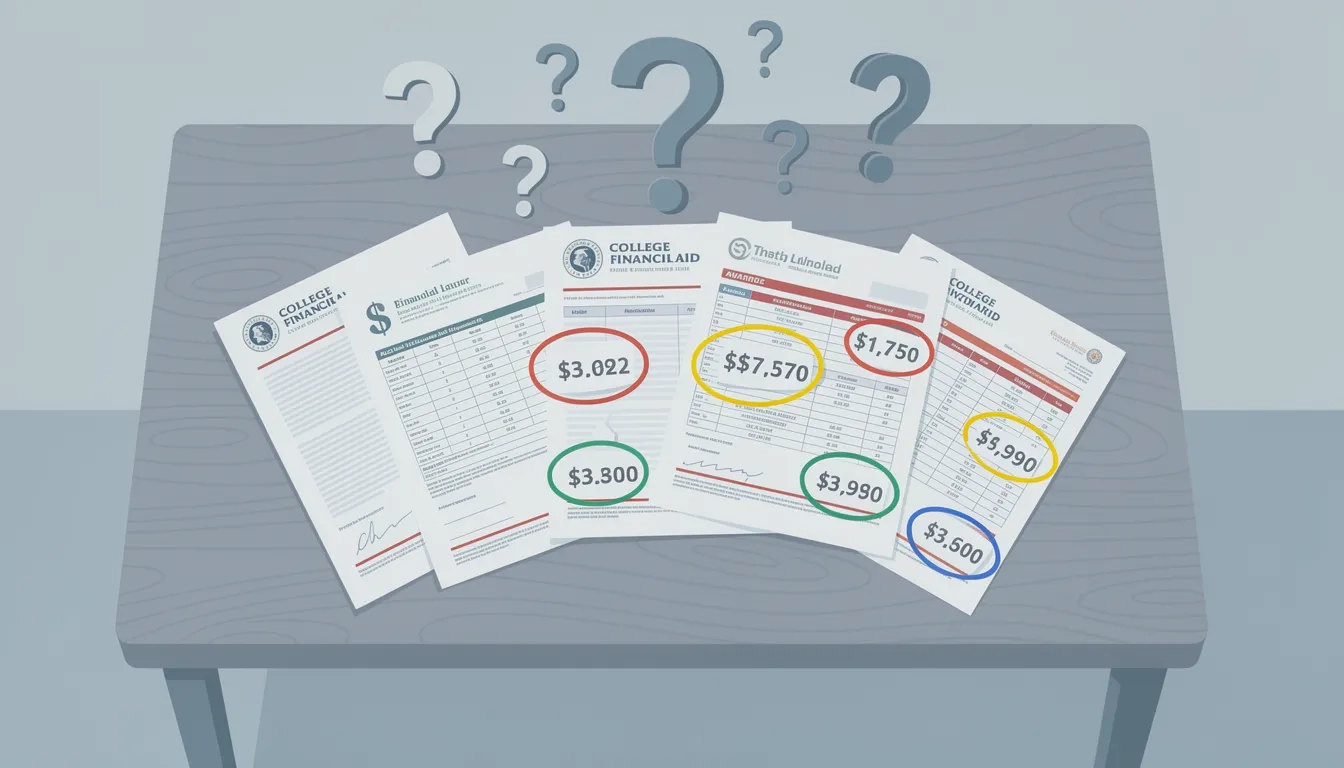
A family gets three financial aid letters in the same week. The first school shows "$42,000 in financial aid." The second shows "$31,000." Based on those numbers alone, school one looks dramatically cheaper — until you realize that $18,500 of it is loans. School two's $31,000 is almost entirely grants. The supposedly cheaper school ends up costing thousands more. This kind of confusion is completely normal, and completely avoidable once you know what to actually compare.
Why Aid Letters Are Designed to Confuse You
There's no federal rule requiring colleges to format financial aid letters the same way. Some schools list grants and loans together under a single "financial aid" line. Others separate them clearly. A few use proprietary terms like "merit award" or "institutional gift" that don't tell you whether the money is free or borrowed.
This inconsistency is the core problem. Packaging loans alongside grants makes an offer look more generous than it is. A school with $15,000 in grants and $12,000 in loans appears to be offering $27,000. A school with $22,000 in grants appears to offer less. It's offering more.
The National Association of Student Financial Aid Administrators (NASFAA) created a free Aid Offer Comparison Worksheet specifically because students couldn't make sense of these inconsistent formats. Download it before you sit down with multiple letters. Or build your own spreadsheet. Either way, the move is to strip out loans and work-study first, and look only at free money.
One more wrinkle: some schools combine direct costs (tuition, fees, room, board) with indirect costs (books, transportation, personal expenses) in their Cost of Attendance, while others separate them. That distinction matters more than it looks, because indirect costs vary significantly by location. A school in a high cost-of-living city can carry $4,000 more per year in indirect expenses than a rural campus, and that rarely appears anywhere obvious in the aid letter.
The Only Number That Actually Matters: Net Price
Here's the figure that should drive every decision you make about these packages.
Net Price = Cost of Attendance minus grants and scholarships, and only those. Loans don't count. Work-study doesn't count. Subtract free money, and stop there.
Cost of Attendance (COA) covers everything: tuition, fees, room and board, books, transportation, and personal expenses. Schools are required to publish this number. It's almost always higher than advertised tuition because tuition alone doesn't tell the full story.
From COA, subtract every grant and scholarship in the package. That remainder is your net price — the actual amount your family needs to cover through some combination of savings, income, borrowing, or outside scholarships. A school charging $68,000 per year but offering $45,000 in grants leaves you at $23,000. A school charging $48,000 but offering only $18,000 in grants leaves you at $30,000. The expensive school wins, by $7,000 per year.
Over four years, that's $28,000. Families anchored to sticker prices miss this over and over.
Unmet need is a related concept worth understanding. It's what's left after your Student Aid Index (SAI, which replaced the old Expected Family Contribution in 2023), your grants, your loans, and your work-study still don't cover the full COA. Some schools commit to meeting 100% of demonstrated financial need. Many don't. Even schools that do "meet full need" often include significant loans in that calculation — so the phrase deserves scrutiny, not automatic trust.
Building Your Side-by-Side Comparison
A spreadsheet is your best tool here. College Raptor and Scholarships360 both offer free online comparison calculators if you prefer a guided interface, but a simple sheet works just as well.
Build one row per school and fill in these columns:
| Column | What to Enter |
|---|---|
| School Name | — |
| Cost of Attendance (annual) | Published COA from school website |
| Total Grants & Scholarships | Free money only, no loans |
| Net Price | COA minus grants/scholarships |
| Subsidized Loans Offered | Track separately from grants |
| Unsubsidized Loans Offered | Track separately from grants |
| Work-Study Offered | Note: not guaranteed income |
| Annual Funding Gap | Net price minus family resources |
| 4-Year Projected Cost | Annual gap × 4, adjusted for tuition increases |
The Annual Funding Gap column is the one that clarifies everything. It shows exactly how much borrowing (or additional savings or income) each school actually requires per year, regardless of how the letter was framed.
Work-study is an offer, not a paycheck. It depends on finding a qualifying on-campus job, and those aren't always available or convenient. Don't count it as covered money when calculating your gap. Treat it as a best-case bonus.
Once you have this spreadsheet filled in, the comparison becomes obvious. Schools that looked unaffordable may look reasonable. Schools that looked like bargains may look expensive. That's the point.
The Four-Year Trap: Don't Trust Year One
This is where most families get burned. Colleges have no obligation to maintain grant amounts from year to year. Some schools offer larger grants freshman year to attract students, then quietly reduce them afterward. This practice is called front-loading, and it's far more common than college marketing materials suggest.
Before accepting any offer, ask the financial aid office three direct questions:
- Is this grant renewable for all four years?
- What GPA or credit-hour requirements must I meet to keep it?
- How have grant amounts for current sophomores and juniors compared to what they received as freshmen?
That third question catches people off guard. But the answer matters enormously. A school offering $24,000 in grants freshman year that drops to $18,000 in years two through four is worse than a school offering a flat $21,000 with a 2.8 GPA requirement — by a lot.
Schools that guarantee to meet 100% of demonstrated need are a meaningful tier above those that don't, but even that phrase needs unpacking. "Meeting full need" often includes loans counted toward that 100%. A school that covers your full need with 60% grants and 40% loans is a different proposition than one covering it with 90% grants and 10% loans.
Add a four-year projection to your spreadsheet (adjusting for roughly 3–4% annual tuition increases, which is about the historical average for private four-year colleges). Year-one net price alone undersells your actual commitment. Moving the goalposts is easiest when you're already enrolled and committed, so nail down renewability terms before you sign anything.
Decoding the Loans in Your Package
Loans belong in your comparison, but as a completely separate category from aid. Not all loans are equal, and accepting them in the wrong order costs money. Here's the right sequence:
- Subsidized federal loans — interest doesn't accrue while you're enrolled at least half-time. The government absorbs it.
- Unsubsidized federal loans — interest accumulates from the day of disbursement. It capitalizes (adds to your principal) if unpaid during school.
- Parent PLUS Loans — higher interest rate, in the parent's name, with less flexible repayment options than standard federal loans.
- Private loans — avoid these unless every federal option is exhausted. Variable rates, fewer protections, no income-driven repayment path.
For 2025–26, subsidized and unsubsidized undergraduate loan rates are both fixed at 6.53%. The rates are the same, but the mechanics aren't. On a $27,000 unsubsidized loan, interest that accrues and capitalizes over four years of school can add roughly $4,900 to your principal balance before your first payment is due. That's not trivial.
When comparing packages across schools, pull out subsidized loan amounts as a separate line. A school offering $3,500 in subsidized loans is giving you a structurally better deal than one offering only unsubsidized at the same amount, even if the total "loan" number looks identical.
How to Negotiate for More Money
Most families skip this step entirely. They shouldn't.
Colleges can reconsider packages through a formal process called Professional Judgment, where a financial aid administrator adjusts the data used to calculate your Student Aid Index. Documented special circumstances — a job loss, medical expenses, high dependent care costs, a one-time income event in your FAFSA base year — are all legitimate grounds to request a review.
Competing offers work too. Schools care about yield (the percentage of admitted students who actually enroll), and many will adjust packages when shown a stronger offer from a peer institution. Bring the actual award letter. Frame your appeal as a conversation rather than a demand: "We're genuinely excited about [School] but are trying to understand the difference between this package and what [Comparable School] provided." That tone gets results. Aggressive or transactional letters rarely do.
A few things worth knowing about timing and logistics:
- The National Candidate Reply Date is May 1. File appeals as soon as you have all your offers, not in the final two weeks.
- Appeals typically take one to three weeks to process. Financial aid offices get overwhelmed as May 1 approaches.
- If your household income has dropped since you filed FAFSA, document it. A pay stub showing reduced hours or a layoff notice carries real weight.
One detail that surprises most families: parent-owned 529 savings plans are assessed at a maximum rate of 5.64% in SAI calculations, while student-owned assets can be assessed at up to 20%. If savings are in the wrong account owner's name, that's a legitimate issue to raise during a professional judgment review.
Bottom Line
- Net price is the only number worth comparing. Cost of Attendance minus grants and scholarships. Loans are debt, not aid.
- Build a four-year spreadsheet before making any decision. Year-one packages routinely look better than years two through four, especially at schools that front-load grants.
- Ask about renewability at every school. GPA thresholds and shrinking grants are the most common traps in this process. Get the terms in writing if possible.
- Accept loans in order: subsidized first, unsubsidized second, PLUS loans last. Avoid private loans unless federal options are fully exhausted.
- Negotiate. If your financial situation changed or a peer school offered more, submit a professional judgment appeal before May 1. The worst outcome is that nothing changes — but often something does.
The single most expensive mistake families make is choosing a school based on the headline aid number instead of calculating what they'll actually owe. Take an afternoon, build the spreadsheet, and decide with real numbers.
Frequently Asked Questions
What's the difference between a financial aid offer and a financial aid award letter?
They're the same document with different names. Some colleges call it an "aid offer," others an "award letter," and some have entirely branded names. Regardless of the label, look for the same four components: grants, scholarships, loans, and work-study. The name doesn't affect what's inside.
Is it really true that a more expensive school can end up costing less than a cheaper one?
Yes, and it happens constantly. A school with a $65,000 sticker price offering $43,000 in grants leaves you at $22,000. A school with a $42,000 sticker price offering only $14,000 in grants leaves you at $28,000. Always calculate net price before ruling a school unaffordable — or assuming a lower-cost school is actually a bargain.
Can a college rescind my admission if I appeal my financial aid package?
No. Appealing a financial aid offer is a normal, expected part of the process. Schools anticipate it. As long as your appeal is honest and professional, your admission is not at risk. This fear stops a lot of families from asking for money they could legitimately receive.
What is "unmet need" and why should I pay attention to it?
Unmet need is the gap remaining after your SAI, all grants, all loans, and work-study still don't cover your full Cost of Attendance. It represents real money your family needs to find somewhere — private scholarships, savings, or additional income. Calculating it at each school reveals which offers are actually workable, independent of how the aid letter presents the numbers.
How do I spot front-loaded financial aid before I enroll?
Ask the financial aid office whether your grant is guaranteed renewable for four years and what the requirements are. Then ask how grant amounts for current sophomores compare to what freshmen received two years ago. A significant drop is a clear front-loading signal. Some schools publish multi-year average aid data — it's worth requesting before you commit.
When is the best time to submit a financial aid appeal?
As soon as you have received all your offers, ideally by early April. The National Candidate Reply Date is May 1, and most appeals take one to three weeks to process. Waiting until the final week risks a rushed or incomplete response. Most families have a much narrower window than they realize.
Sources
- Comparing School Financial Aid Offers - Federal Student Aid
- FAFSA Strategy 2026-27: Maximize Aid, Compare Offers, and Negotiate - Dewey Smart
- Comparing financial aid offers? Here are 3 options - Granite Edvance
- Understanding Financial Aid Offers - Scholarship America
- How to Review and Compare Your Financial Aid Awards - BigFuture/College Board
- Aid Offer Comparison Worksheet - NASFAA