Community College vs University Cost: What the Numbers Actually Show
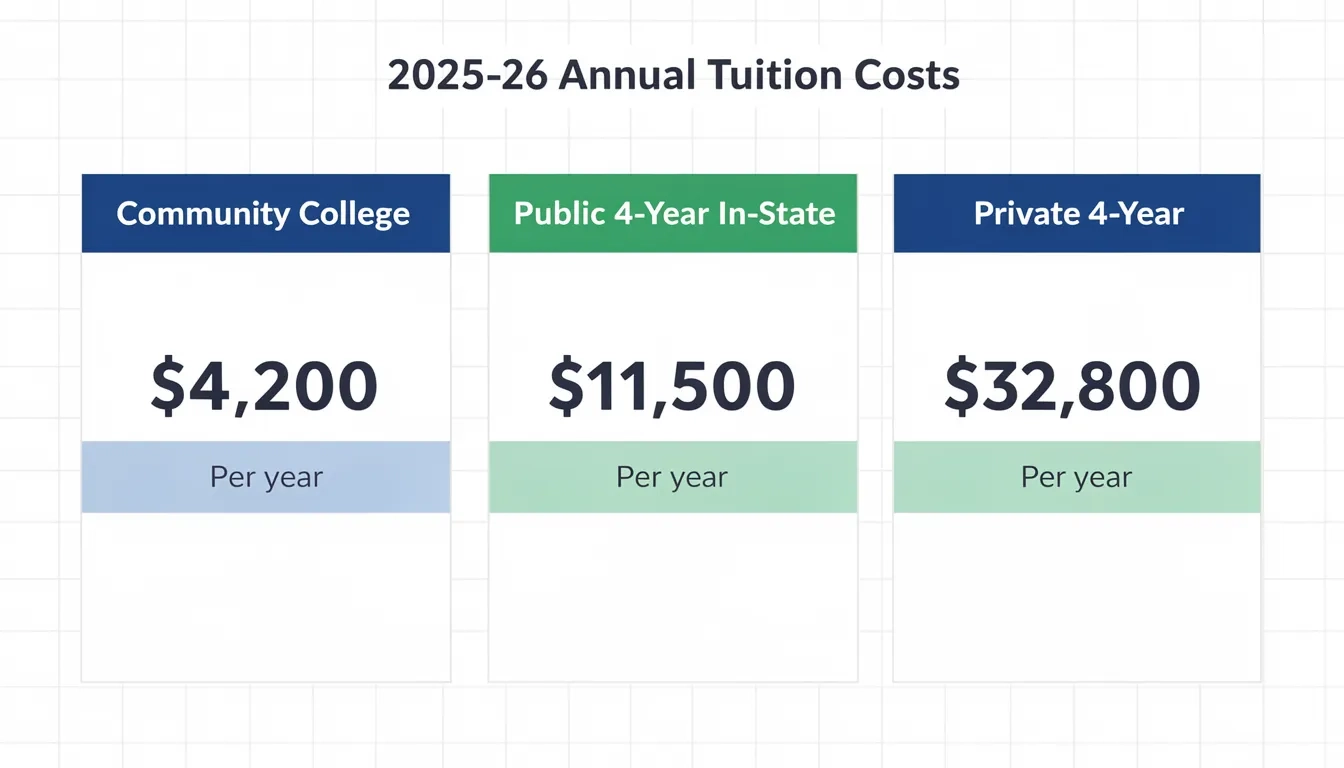
The gap between $4,150 and $45,000 is hard to look away from. Those are the 2025-26 average published tuition figures for a public community college versus a private nonprofit university, pulled straight from the College Board's annual Trends in College Pricing report. And yes, that's a real number. The sticker price at a private four-year school is nearly eleven times what you'd pay at a community college.
But sticker prices lie. Or more precisely, they tell only part of the story — and for most students, not even the most important part. To actually compare these two paths, you need to look at net price, total cost of attendance, financial aid patterns, and what happens to your earnings afterward.
That's what this breakdown does.
The Raw Numbers, Side by Side
Before anything else, here's what published tuition looks like across institution types for 2025-26, based on College Board data:
| Institution Type | Published Tuition & Fees |
|---|---|
| Public community college (in-district) | $4,150/year |
| Public 4-year university (in-state) | $11,950/year |
| Public 4-year university (out-of-state) | $31,880/year |
| Private nonprofit 4-year university | $45,000/year |
Community college tuition is 35% of what in-state public university students pay in sticker price. Against a private school? It's barely 9 cents on the dollar.
Geography shifts these numbers significantly. California's community colleges charge just $1,440 per year — the lowest in the nation. Vermont's average hits $8,900. So a California community college student pays less per year than a Vermont student pays per semester. Where you live determines a surprisingly large chunk of the cost equation before you've even applied.
Why "Total Cost of Attendance" Changes the Conversation
Tuition is only one line item. Rent, food, books, transportation — those costs don't disappear just because your tuition is low. When you factor everything in, the gap between community college and university narrows.
The average total cost of attendance at a public community college runs about $20,057 per year for state residents, according to the Education Data Initiative. The average for all colleges nationally sits around $38,270. That's still a massive gap, but it's not the 11-to-1 ratio you see with tuition alone.
Here's why the full COA picture matters: most community college students commute from home. No dorms, no meal plans. That alone can strip $10,000 to $15,000 from the annual bill. University students — especially freshmen at residential schools — often have no choice but to pay for on-campus housing, at least for the first year.
A student choosing between Ivy Tech Community College in Indiana and Indiana University Bloomington isn't just comparing $4,000 to $12,000 in tuition. They're comparing a commute from their parents' house against a room and board package that can push the real annual cost past $30,000.
The 2+2 Strategy: The Most Underused Cost Hack in Higher Education
Here's the move that most cost comparisons bury in a footnote: spend two years at a community college completing general education requirements, then transfer to a four-year university to finish a bachelor's degree. The degree on your diploma says the university's name. The cost is roughly half what four years at that university would have run.
The math works like this:
- Two years at a community college at $4,150/year in tuition = ~$8,300
- Two years at a public in-state university at $11,950/year = ~$23,900
- Total: ~$32,200 for a bachelor's degree path
Compare that to four straight years at the public university: ~$47,800. You've saved over $15,000 in tuition alone, before accounting for room and board differences.
Transfer agreements formalize this. Many state systems have articulation agreements that guarantee credit transfer between their community colleges and flagship universities. California's system is probably the most developed — community college students who meet certain GPA requirements are guaranteed admission to a UC campus under the Transfer Admission Guarantee program. That's not a maybe. That's a contractual right.
The catch is that not all credits transfer cleanly. A student who takes courses without checking articulation agreements can lose a semester's worth of work — and money — when their new school won't accept credits that don't map to required coursework. Check the specific transfer agreement before enrolling, not after.
Net Price: The Number That Actually Hits Your Bank Account
Sticker price is what schools advertise. Net price is what you pay after grants and scholarships.
"Community college students have received enough grant aid to cover their tuition and fees, on average, since 2009-10." — College Board, Trends in College Pricing 2025-26
That's not a typo. For students who receive any federal or state grant aid, the average net tuition at a public two-year college has effectively been zero for over fifteen years. The Pell Grant alone covers the full sticker price for qualifying low-income students.
Four-year schools look better on this metric than their sticker prices suggest too. The estimated net tuition at public four-year institutions dropped from a peak of $4,450 in 2012-13 to about $2,300 in 2025-26, after adjusting for inflation. Private nonprofits average around $16,910 in net costs after grants.
The income gap still shapes outcomes sharply. College Board data shows that between 1994 and 2024, families in the top income bracket saw 58% inflation-adjusted income growth. Families in the lowest bracket saw 33%. The sticker price increases at universities have disproportionately hit families who had the least room to absorb them, which is a big part of why community college enrollment patterns look the way they do.
Here's a practical decision framework based on net price:
- File the FAFSA first. You can't know your actual cost at any institution until you have an aid offer in hand.
- Compare net price, not tuition. The Net Price Calculator on every school's website gives a rough estimate before applying.
- Check if your state has free community college. 34 states currently offer some form of tuition-free community college for qualifying students.
- If you're Pell-eligible, community college is almost certainly free. The numbers bear this out nationally.
Does Where You Start Actually Affect What You Earn?
The honest answer: it depends on what you're comparing.
An associate degree on its own does carry an earnings premium over a high school diploma — the Bureau of Labor Statistics consistently shows this. But the gap between an associate degree and a bachelor's degree is significant. In California, bachelor's degree holders in 2024 had median annual wages near $90,000 versus much lower figures for workers without four-year credentials.
What the research doesn't support is the idea that employers penalize you for starting at a community college. If you transfer and complete your bachelor's at State University, your transcript says State University. Hiring managers reading a resume from someone who graduated from University of Texas Austin don't typically investigate whether that person spent their first two years at Austin Community College.
The caveat here is specific fields. Law school and medical school applications often scrutinize the full undergraduate record. Some competitive engineering programs weigh institutional prestige during admissions. For those tracks, starting at a community college requires careful planning, not avoidance, but careful planning.
Who Each Path Actually Makes Sense For
This is where I'll give you a real answer rather than a both-sides hedge.
Community college is the smarter financial choice for most students who are undecided about their major, need flexibility, or are cost-constrained. Period. The 2+2 pathway is not a consolation prize. Plenty of lawyers, engineers, and executives started at two-year schools.
Where four-year universities justify the premium:
- Specific programs unavailable at community colleges — some engineering, architecture, and fine arts programs simply don't have two-year equivalents
- On-campus research opportunities — relevant if you're targeting graduate school or academic careers
- Strong alumni networks in fields where connections matter from day one (investment banking, consulting, entertainment)
- When financial aid makes it cost-competitive — some private schools with large endowments actually cost less net than public universities for low-income students
Where community college wins outright:
- You're working while enrolled
- You need to live at home for financial or family reasons
- You haven't declared a major and want cheaper "exploration credits"
- You're in California, where the community college system is genuinely world-class
The elephant in the room in all these comparisons is student debt. Nationally, students who start at community colleges graduate with significantly less debt than those who attend four-year schools from the start. Given that $37,338 is the average federal student loan balance for borrowers who attended public universities, that gap has multi-decade financial consequences.
The average community college student carries substantially less. The compounding cost of interest on even $20,000 in loans taken out at 22 shapes your 30s in ways that feel abstract when you're 18.
Bottom Line
- If cost is your main constraint, community college, especially with the 2+2 transfer strategy, cuts degree costs roughly in half compared to four straight years at a public university.
- Net price is what matters, not sticker price. File the FAFSA, use net price calculators, and compare real out-of-pocket costs before choosing.
- Verify transfer agreements before you enroll at a community college with transfer intent — articulation agreements are your legal protection that credits will count.
- The earnings gap between a bachelor's degree and an associate degree is real and large; community college is most powerful as a launch pad to a four-year degree, not necessarily as a final destination.
- For most students, starting at a community college and transferring is not a plan B. It's a better financial plan than most families realize.
Frequently Asked Questions
Is a community college degree worth less than a university degree to employers?
For an associate degree alone, some employers do factor in credential level. But if you use community college as a transfer pathway and graduate with a bachelor's from a four-year institution, the degree carries the university's name. Most employers won't know or ask where you started. The exception is highly selective fields like finance or consulting where the prestige of the undergraduate institution sometimes factors into initial recruiting.
Can I really transfer all my community college credits to a university?
Not automatically. Credit transferability depends on whether your state has formal articulation agreements and whether you took the right courses. California's TAG (Transfer Admission Guarantee) program is one of the strongest examples of a system-wide guarantee. In other states, check the specific articulation agreement between your community college and your target university before you register for classes.
How much student debt do community college students typically graduate with?
Community college students graduate with far less debt than four-year university students, largely because tuition is lower and many commute from home. The national average federal loan balance for public university borrowers is around $37,338. Community college students who transfer and complete a bachelor's degree typically borrow less overall because they paid lower rates for their first two years.
Is community college actually free in some states?
Yes. 34 states currently offer some form of scholarship or promise program that covers tuition at community colleges for qualifying students. Tennessee Promise, New York's Excelsior Scholarship, and Oregon Promise are among the most well-known. Eligibility varies by income, GPA, and enrollment status. Even without a state program, Pell Grant recipients have effectively had their tuition covered at community colleges since around 2009, based on average grant amounts versus average tuition.
What's the real cost difference for a full bachelor's degree using the 2+2 path vs. four years at a university?
Using 2025-26 published tuition figures: two years at a community college ($4,150/year) plus two years at a public in-state university ($11,950/year) totals roughly $32,200 in tuition. Four straight years at the same public university runs about $47,800. That's a $15,619 difference in tuition before accounting for room and board — and community college students who live at home during those first two years often save an additional $20,000 or more in housing and food costs.
Sources
- Trends in College Pricing Highlights – College Board Research
- Average Cost of Community College [2025] – Education Data Initiative
- Average Cost of College [2026] – Education Data Initiative
- Community College vs University: Cost, Quality & Career Outcomes – CommunityCollegeReview
- Average Cost of Community College by State for 2026 – Research.com