College Student Legal Rights: What Every Student Should Know
Most students spend zero minutes thinking about their legal rights before arriving on campus. Then something happens — a disciplinary notice arrives, a parent calls the registrar, campus police knock on a dorm room door — and suddenly they're inside a bureaucratic system built by lawyers and run by administrators who assume everyone already knows the rules.
You almost certainly don't. That's not your fault. But it's worth fixing before something goes sideways.
The Legal Shift Nobody Warns You About
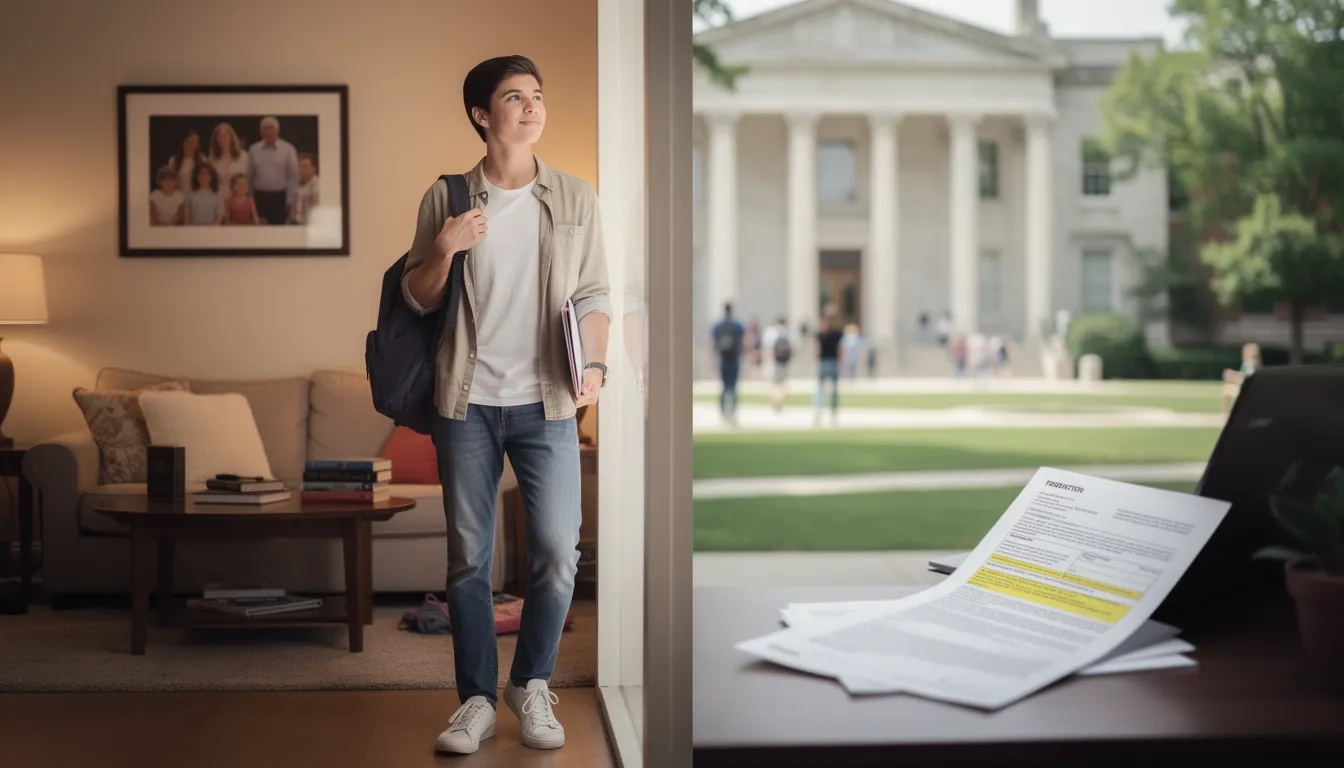
The moment you enroll in college, a genuine legal transformation happens. Less talked about than freedom from curfews, it matters considerably more.
The controls your parents held in high school transfer to you in college. They had access to your records, authority in disciplinary proceedings, and formal standing with your school. In college, federal law hands those rights directly to you — regardless of who pays tuition.
This happens because once you turn 18 or enroll in a postsecondary institution, the Family Educational Rights and Privacy Act (FERPA) classifies you as an "eligible student." The practical result: your parents cannot call the registrar, request your grades, or obtain your disciplinary history without your written consent. That firewall is federal law, not a school policy that can be waived.
The disability framework flips too. In K-12, the Individuals with Disabilities Education Act obligates schools to proactively identify students with disabilities and create support plans. In college, that obligation disappears entirely. The ADA still protects you, but you have to register with disability services yourself, provide documentation, and request accommodations before each semester. The school isn't coming looking for you.
This shift toward full self-advocacy runs through every right that follows.
FERPA: Your Records Are Yours
Your right to inspect your own education records is absolute and vastly underused. Under FERPA, you can request any document the school maintains about you — grades, transcripts, financial aid files, disciplinary records — and the institution must respond within 45 calendar days of your written request.
You can also challenge inaccuracies. If a grade was recorded incorrectly or a conduct file contains factual errors, you can formally request a hearing before an impartial decision-maker to correct it. Most students never do this because most students don't know it exists.
The lesser-known trap is directory information. Schools share your name, enrollment status, major, and email address with outside parties by default, unless you actively opt out. The opt-out process takes about five minutes and is usually buried in your student portal. Check it before the end of your first semester.
Situations where schools can share your information without consent:
- School officials with a documented educational interest in your records
- Transfer institutions you're actively applying to
- Financial aid administration
- Valid court orders or subpoenas
- Health or safety emergencies
- Your parents, if you're still their legal tax dependent (though most schools won't, even then)
The protection runs on by default, but the exceptions are real. Know what your institution shares and with whom.
Free Speech on Campus: Where You Go Matters
This area has the widest gap between what students believe and what's actually true.
The First Amendment applies only at public universities. State schools are government actors, and the government cannot restrict speech based on its content or viewpoint. A public university that shuts down a student protest because administrators dislike the message is breaking constitutional law, full stop.
Private universities work differently. They're not government actors, so the First Amendment doesn't bind them directly. Harvard, Fordham, and Northwestern can enforce speech policies that would be unconstitutional at Michigan or Texas.
There's a catch, though. Many private schools have voluntarily committed to free expression principles in their student handbooks, and those commitments become enforceable contracts. If a school's handbook promises free speech protection and then disciplines a student for a political statement, that student has a legitimate breach-of-contract claim. Courts have taken this theory seriously.
At public universities, the campus is legally a marketplace of ideas. The institution can regulate when and where speech happens — but almost never what is said.
Public schools use "time, place, and manner" restrictions without running afoul of the First Amendment. They can require permits, designate assembly zones, and set noise limits. What they can't do is apply those rules selectively, allowing a rally on one side of the political spectrum while blocking one on the other. That's viewpoint discrimination, and courts treat it as a serious constitutional violation.
FIRE's 2025 College Free Speech Rankings found widespread self-censorship on major campuses — students avoiding certain topics because they're unsure what their school allows. That chilling effect is itself a free speech problem, even when no formal punishment ever happens.
Title IX and Sexual Misconduct in 2025
Title IX is 37 words long. The regulations built on top of it span thousands of pages, and in 2025, those regulations changed again.
The Trump administration reinstated the 2020 Title IX rules, vacating the Biden-era framework that had briefly taken effect at some schools. Under the current standard, sexual harassment must meet a "severe, pervasive, and objectively offensive" threshold to trigger protections. A single offensive comment typically won't clear that bar. The rules also limit coverage to conduct occurring on campus or within school-sponsored activities — off-campus incidents trigger school obligations only in specific circumstances.
What hasn't changed under any administration: every school receiving federal funds must appoint a Title IX coordinator, offer supportive measures to reported victims even without a formal complaint (schedule changes, no-contact orders, campus escorts), and conduct a fair investigation when a formal complaint is filed.
| What you want | Where to go | Key deadline |
|---|---|---|
| Campus support without formal hearing | Title IX coordinator | No hard deadline |
| Formal investigation and hearing | Title IX coordinator (formal complaint) | School-specific |
| Federal complaint against the school | Dept. of Education OCR | 180 days from incident |
| Lawsuit against the school | Federal or state court | Varies by state |
One non-obvious point: you can file a federal complaint even after campus proceedings conclude, as long as it's within 180 days of the incident or 60 days after the school's internal process ends. Your options don't close when the campus case closes.
Campus Discipline: The Due Process Gap
This should concern anyone paying attention.
Campus disciplinary proceedings can result in expulsion, permanent transcript notations, and career consequences that follow students for decades. Yet most of these hearings occur with fewer procedural safeguards than a parking ticket appeal. Schools adjudicate conduct as serious as sexual assault with standards no criminal court would tolerate.
FIRE's analysis of policies at the top 53 universities found that 71.7% do not explicitly guarantee students a presumption of innocence. Nearly 42% don't require impartial fact-finders. These aren't obscure schools — they're flagship state universities and major private institutions.
At public universities, the 14th Amendment's due process clause sets a constitutional floor. The Supreme Court's 1975 decision in Goss v. Lopez established that even a short suspension requires notice of charges and a chance to respond. Courts have since required more for serious sanctions:
- Written notice of specific charges before any hearing
- Disclosure of the evidence being used against you
- A real opportunity to present your side of the story
- An impartial decision-maker with no conflict of interest
- A written decision with the reasoning explained
- A meaningful appeal process
Private universities aren't constitutionally bound to these standards, but they are bound to their own written policies. If your handbook describes a specific hearing process, the school must follow it. That's an enforceable contract.
The most common student mistake is treating a disciplinary hearing as an informal conversation. Students show up unprepared, make statements without understanding the specific charges, and miss appeal windows. Even a one-semester suspension can complicate graduate school applications and certain professional licensing processes. Read your handbook. Ask for everything in writing.
Your Dorm Room and the Fourth Amendment
Students at public universities have genuine Fourth Amendment protection in their dorm rooms. Courts have held that dormitory rooms carry a reasonable expectation of privacy comparable to a private residence. Law enforcement cannot search one without a valid warrant, absent recognized exceptions like consent or a genuine emergency.
The line between university administration and law enforcement is where things get complicated. Schools retain authority to inspect rooms for health, maintenance, and safety purposes, and those inspections are generally lawful. Unless they're pretextual. If campus police, rather than facilities staff, are leading a "routine maintenance visit," that's a meaningful distinction that affects whether evidence found could be admitted in court.
Private school students have messier protections. Campus security at private institutions may not qualify as government actors, which affects whether the Fourth Amendment applies directly to their searches. But any evidence handed to municipal police will still be examined by courts for whether the handoff was designed to work around constitutional requirements.
The practical rule: never consent to a search you're not legally required to consent to. Saying "I do not consent to this search" doesn't stop a lawful one. But it preserves your legal arguments if the search turns out to have been improper.
Disability Accommodations: The College Version Is Different
The ADA and Section 504 of the Rehabilitation Act cover virtually every American college because both laws apply to institutions receiving federal funding — and almost none decline it.
The difference from high school is structural. In K-12, schools find students with disabilities and create individualized plans. In college, you register yourself. You gather documentation. You submit formal requests before each semester you need accommodations. A student who received IEP support through twelfth grade gets nothing automatically at the college level.
Documentation requirements vary and are worth scrutinizing. Some schools accept a letter from your treating physician. Others require a full evaluation by a licensed neuropsychologist — assessments that run between $1,847 and $4,500 depending on your region, a real barrier for students without insurance or family resources. The legal standard is "reasonable" documentation, not a complete clinical workup. If your school's documentation demands feel excessive, push back in writing.
Common accommodations students frequently don't know to request:
- Extended exam time (typically 1.5x or 2x standard)
- Alternative testing environments for students with sensory processing differences
- Note-taking assistance or lecture recording permissions
- Priority course registration for students whose treatment schedules create conflicts
- Housing modifications for physical or medical conditions
Schools are legally required to engage in an "interactive process" to find workable solutions — genuine back-and-forth, not a form rejection. A flat refusal without discussion isn't legally defensible. Document every exchange you have with disability services.
Bottom Line
Most of these rights operate on the same principle: they protect you by default, but only if you know they exist and actively exercise them.
- At the start of every semester, review your school's FERPA directory information settings and opt out if you haven't already.
- If you receive a disciplinary notice, immediately request the specific charges and supporting evidence in writing. Ask which handbook procedures apply. Do not attend any hearing without reading those procedures first.
- For Title IX matters, know that your campus Title IX coordinator must offer supportive measures regardless of whether you want a formal hearing. The federal 180-day OCR complaint window runs from the incident date.
- For disability accommodations, register with disability services early — before a problem arises, not after your first failed exam.
- If campus police request to search your room, state clearly that you do not consent, and contact student legal services immediately.
The elephant in the room is that most universities benefit from students not knowing these rights. Not through malice — through institutional inertia. Students who understand the rules move through campus administration differently. Be one of them.
Frequently Asked Questions
Can my parents see my college grades without my permission?
No. FERPA transfers full control of education records to students when they turn 18 or enroll in any postsecondary institution. Your parents — regardless of whether they pay tuition — have no legal right to request your grades, transcripts, or disciplinary records without your written consent. Some institutions will share records with parents if you're still claimed as a tax dependent, but federal law doesn't require it, and most schools won't.
Does the First Amendment protect my speech at a private college?
Not directly. The First Amendment constrains only government institutions, and private universities aren't government actors. That said, if your private school's student handbook explicitly promises free expression protections, that's an enforceable contract. Students have successfully challenged private university speech restrictions using breach-of-contract theory — no constitutional argument needed.
What's the minimum due process I'm entitled to in a campus disciplinary hearing?
At public universities, the Supreme Court's decision in Goss v. Lopez established that even a short suspension requires notice of charges and a chance to respond. Suspension or expulsion triggers stronger protections: written notice, evidence disclosure, an impartial hearing, a written decision with reasoning, and a meaningful appeal. Private universities must follow whatever procedures their own handbooks describe — that's the contractual floor, and courts enforce it.
Is it really true that most colleges don't guarantee a presumption of innocence?
Documented, not a myth. FIRE's analysis of conduct policies at the top 53 universities found that 71.7% do not explicitly guarantee a presumption of innocence in disciplinary proceedings. This doesn't mean every school assumes guilt by default, but the absence of an explicit standard creates serious ambiguity in high-stakes cases, especially sexual misconduct hearings where consequences can be severe and permanent.
What should I do immediately when I receive a campus disciplinary notice?
Ask in writing whether this is an investigatory conversation or a formal proceeding — that distinction determines your procedural rights. Request the specific charges and all evidence the school intends to use. Read your student handbook's disciplinary procedures before responding to anything. For cases that could result in suspension or expulsion, contact your campus student legal aid office or a private attorney before attending any meeting. Never assume a conversation is informal just because nobody used the word "hearing."
Sources
- College Student Rights - FIRE
- Due Process on College Campuses - FIRE
- FERPA - Protecting Student Privacy - U.S. Department of Education
- Speech on Campus - ACLU
- Know Your Rights: Sexual Harassment and Assault on Campus - AAUW
- How Student Rights Change from High School to College - GovFacts
- Student Disciplinary Proceedings: Due Process Rights - Nisar Law Group
- 2025 College Free Speech Rankings - FIRE