Disability Accommodations in College: Your ADA Rights Explained
When you leave high school, the system that tracked your disability leaves with you. Your IEP ends. Your 504 plan does not automatically transfer. And the college — whether it's a flagship state university or a small private school — has no legal obligation to identify you or come find you.
Most students discover this the hard way, usually mid-semester when they're already behind.
According to data compiled by Best Colleges, only 37% of students with disabilities formally reported their disability to their college between 2009 and 2016 — even though roughly 20.5% of all undergraduates reported having a disability as recently as 2019-2020. That gap between who qualifies for support and who actually gets it is the elephant in the room of higher education disability policy.
The good news: once you understand the rules, the law is genuinely on your side. Here's what you actually need to know.
The Biggest Shift From High School
In K-12, the Individuals with Disabilities Education Act puts the burden on schools. They must find, evaluate, and serve you. That framework ends the day you receive a college acceptance letter.
The Americans with Disabilities Act and Section 504 of the Rehabilitation Act take over in college. Both are civil rights laws, not service delivery laws. They prohibit discrimination. They do not require schools to go looking for students who might need help.
The practical result: you must disclose. You must document. You must make the request. Faculty won't flag you, and the disability office won't come calling. This isn't a bureaucratic failure — it's the deliberate design of the law, built around treating you as an autonomous adult.
The Laws That Protect You
Two federal laws form the backbone of your rights, and they cover a lot of the same ground.
The ADA (Americans with Disabilities Act) applies to both public and private colleges. Title II covers public institutions — state universities, community colleges, vocational schools. Title III covers private colleges as "places of public accommodation." Together, they bar discrimination in admissions, coursework, housing, extracurriculars, and career services.
Section 504 of the Rehabilitation Act applies to any school that receives federal funding. Practically speaking, that means almost every college and university in the country. Under Section 504, schools must provide equal access across all their programs and services.
A third law matters specifically in housing: the Fair Housing Act, which kicks in for residence hall accommodations and carries a different definition of "assistance animals" than the ADA does (more on that below).
The 2025 Supreme Court decision in Tharpe v. Osseo Area Schools settled a long-running ambiguity: students cannot be held to a higher standard when proving disability discrimination than adults in any other legal context. The school setting doesn't shrink your rights.
How to Actually Get Accommodations
The process isn't complicated, but it has to happen in the right sequence. Here's the typical path:
Register with the Disability Services Office (DSO) — This is your starting point. Every college must have one, or at minimum a designated 504/ADA coordinator. Do not go directly to professors first.
Submit documentation — You'll generally need records that link your diagnosis to specific functional limitations. A neuropsychological evaluation, a letter from a treating physician, or your prior school records can all work. Ask the DSO what formats they accept before spending money on new testing.
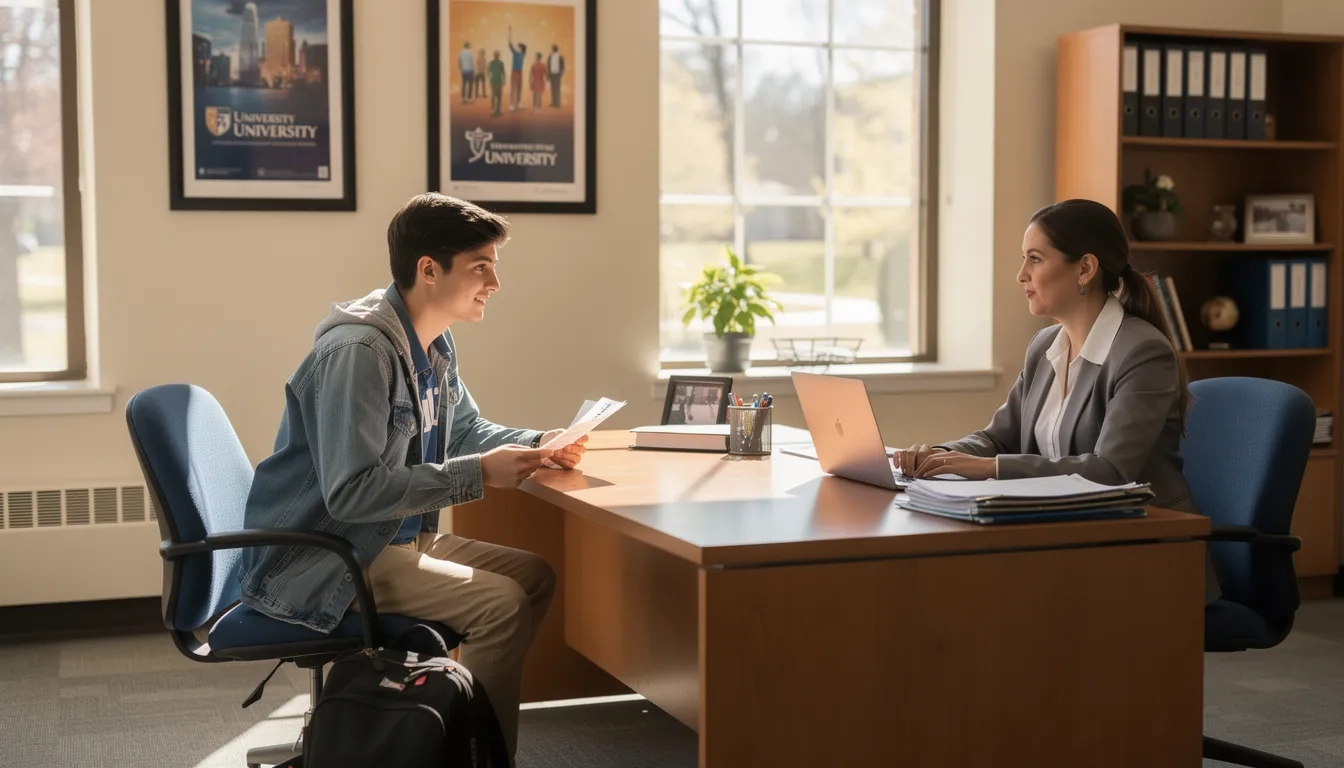
Attend an intake meeting — The DSO engages in what's legally called an "interactive process." They're assessing how your disability affects your access to academics and campus life. Come prepared to explain what you need and why.
Receive your accommodation letter — If approved, you get a formal letter listing your specific accommodations.
Deliver the letter to each professor — Faculty are not notified automatically. You must hand the letter to each instructor, each semester. This step trips up a surprising number of students.
Review and renew each term — Accommodations don't always carry over automatically. Confirm with your DSO at the start of every semester.
One piece most students don't know: a 2024 ruling in White v. Rutgers University found that faculty non-compliance with approved accommodation letters creates real legal liability for the institution. Knowing this gives you standing to push back firmly if a professor resists.
What You Can (and Can't) Request
Common, well-established accommodations include:
- Extended time on exams (usually 1.5x or 2x the standard window)
- Separate, quiet testing rooms
- Note-taking assistance or access to lecture recordings
- Sign language interpreters or real-time captioning
- Accessible formats for printed materials (digital, Braille, large print)
- Priority registration for classes
- Reduced course load without triggering financial aid penalties
The legal limit is the concept of "fundamental alteration." Schools don't have to waive requirements that are core to what your degree actually means. A nursing program isn't required to eliminate clinical patient contact if hands-on care is central to the credential. A music performance degree isn't required to remove live performance requirements.
But schools can't weaponize "fundamental alteration" as a blanket excuse either. The 2024 case Schoper v. Western Illinois University clarified that retroactively improving past grades isn't a required accommodation — but prospective, forward-looking support absolutely is.
Students also frequently overlook that extracurricular programs, athletic facilities, and career services all fall under ADA protection. Not just your exams.
Common misconceptions worth clearing up:
| Misconception | Reality |
|---|---|
| "My IEP carries over to college." | IEPs are K-12 only. You re-document from scratch. |
| "The DSO decides everything automatically." | It's an interactive process — your input shapes the outcome. |
| "My professor can deny my accommodations." | Faculty cannot override DSO-approved letters. |
| "Mental health conditions don't qualify." | Depression, anxiety, PTSD all qualify under ADA definitions. |
| "I only register once." | Many schools require renewal each semester or year. |
Housing: A Different Set of Rules
Campus housing runs on its own track, and the rules shift in ways that catch students off guard.
For general campus access, the ADA governs service animals strictly: only dogs individually trained to perform a specific disability-related task qualify. Staff can ask exactly two questions — whether the animal is required because of a disability, and what task it's trained to perform. Nothing more.
But in residential housing, the Fair Housing Act takes over. The FHA's definition of "assistance animal" is far broader — it includes cats, birds, rabbits, even pigs, as long as the animal provides emotional support for a documented disability. You'll typically need a letter from a licensed mental health provider or physician. The animal doesn't need to be trained to perform a specific task.
Students with physical disabilities can request accessible room assignments, ground-floor placements, or proximity to elevators. Students with dietary disabilities — celiac disease, severe food allergies — often qualify for specialized meal plan accommodations under the same framework.
Practical warning: housing accommodation requests frequently have separate deadlines from academic ones, and they often route through Residential Life rather than the DSO. The GAO's 2024 report (GAO-24-105614) specifically flagged that students who miss these earlier housing deadlines routinely lose the window entirely. Submit as early as the summer before you arrive.
When the System Fails: Escalation Paths
Most disputes get resolved at the campus level. When they don't, you have real options.
First: the DSO or 504/ADA coordinator. Every school must have a grievance procedure. File internally first. Document everything — emails, names, dates — before you do anything else. Ask the school to confirm any denial in writing.
Second: the U.S. Department of Education's Office for Civil Rights (OCR). You can file a complaint online, by mail, fax, or email. No attorney required. The OCR investigates whether the school violated Section 504 or the ADA. There is a 180-day filing deadline from the date of the violation, so don't sit on it.
Third: a private attorney. For significant violations, an ADA attorney can pursue a legal claim. Some take these cases on contingency.
The OCR complaint process is free, doesn't require a lawyer, and has real enforcement teeth — but it only works if you've documented the denial. Get the refusal in writing before you escalate.
The OCR route is consistently underused. Many students assume federal complaints mean years of litigation. In practice, many are resolved through voluntary agreements between the school and the federal government, sometimes in a matter of months.
The Digital Accessibility Gap
Physical and academic accommodations aren't the whole picture anymore.
In April 2024, the Department of Justice issued a final rule requiring public colleges to bring their websites and mobile applications into compliance with Web Content Accessibility Guidelines (WCAG) 2.1, Level AA. Large institutions face a deadline of April 24, 2026; smaller institutions have until April 26, 2027.
This matters practically for students who rely on screen readers, keyboard navigation, or captioning. Course management systems, registration portals, online exam platforms — all of it must be accessible under the new rule. If you're currently hitting walls with inaccessible course software, the DOJ rule is a lever worth knowing about.
Bottom Line
- Start before your first semester. Register with the DSO the summer before you arrive, not during the crisis of midterms. Early registration also protects housing deadlines.
- Bring documentation, but ask first. Your high school records may be enough. Don't spend money on new testing until you know exactly what the DSO requires.
- Your accommodation letter is not self-executing. Hand it to every professor, every semester. Faculty cannot override an approved letter.
- Housing is a separate process. Don't assume DSO registration covers your residence hall request. File through Residential Life, and file early.
- If you're denied, get the denial in writing and escalate. The OCR complaint process is free, accessible, and effective. One hundred and eighty days is your window — don't let it close.
The system is genuinely designed to support you once you're inside it. The barrier is almost always knowing which door to knock on first.
Frequently Asked Questions
Does college have to honor my high school IEP or 504 plan?
No. IEPs are created under the Individuals with Disabilities Education Act, which only governs K-12 education. At the postsecondary level, your prior plan can serve as supporting documentation, but it doesn't grant any automatic entitlements. You'll go through your college's DSO process fresh, starting from your current documentation.
Can a professor refuse to give me extended time on an exam?
No. Once the DSO approves an accommodation, faculty cannot override it. If a professor refuses to honor your approved accommodation letter, report it immediately to the DSO and your 504/ADA coordinator. The 2024 ruling in White v. Rutgers University made clear that faculty non-compliance exposes institutions to significant legal liability — which means the school has strong incentive to enforce its own letters.
Do mental health conditions qualify for accommodations?
Yes. Depression, anxiety disorders, PTSD, bipolar disorder, and ADHD all qualify under the ADA when they substantially limit one or more major life activities. Mental health is now the fastest-growing category of accommodation requests at colleges. A 2024 survey of over 23,000 college students across 38 schools found that nearly 16% reported ADHD alone — the most commonly registered condition.
What if I can't afford the documentation my school is requiring?
Schools cannot shift undue financial burden onto students through documentation demands. If the DSO requires an expensive evaluation you can't afford, say so directly. Many schools have referral agreements with campus health centers or sliding-scale testing providers. In some cases, a letter from a treating physician or existing high school records will suffice — but you have to ask rather than assume.
Does my ADA protection extend to online courses?
Yes. Online courses fall under the same legal framework. Captioning for lecture videos, accessible document formats, screen-reader-compatible platforms, and extended time for online exams are all fair to request. The DOJ's April 2024 rule also requires public institutions to make their digital course platforms WCAG 2.1 compliant by 2026-2027, so the legal pressure on schools to get this right is increasing.
How long does the accommodation approval process take?
It varies by school and by time of year. Some DSOs return decisions within a week; others take four to six weeks when the semester rush hits. Registering the summer before your first term is the single best way to avoid delays. Students who wait until the second or third week of classes often find themselves without approved accommodations for the first set of exams.
Sources
- Navigating Disability Accommodations in Higher Education: Processes, Distinctions, and Best Practices
- ADA National Network: Postsecondary Institutions and Students With Disabilities
- The Rights of College Students with Disabilities — Disability Rights South Carolina
- College Students With Disabilities: Facts and Statistics — Best Colleges
- Higher Education: Education Could Improve Information on Accommodations for Students with Disabilities — U.S. GAO (GAO-24-105614)
- New ADA Title II Accessibility Requirements for Public Colleges — New York State Bar Association