How Owning a Business Affects FAFSA Eligibility
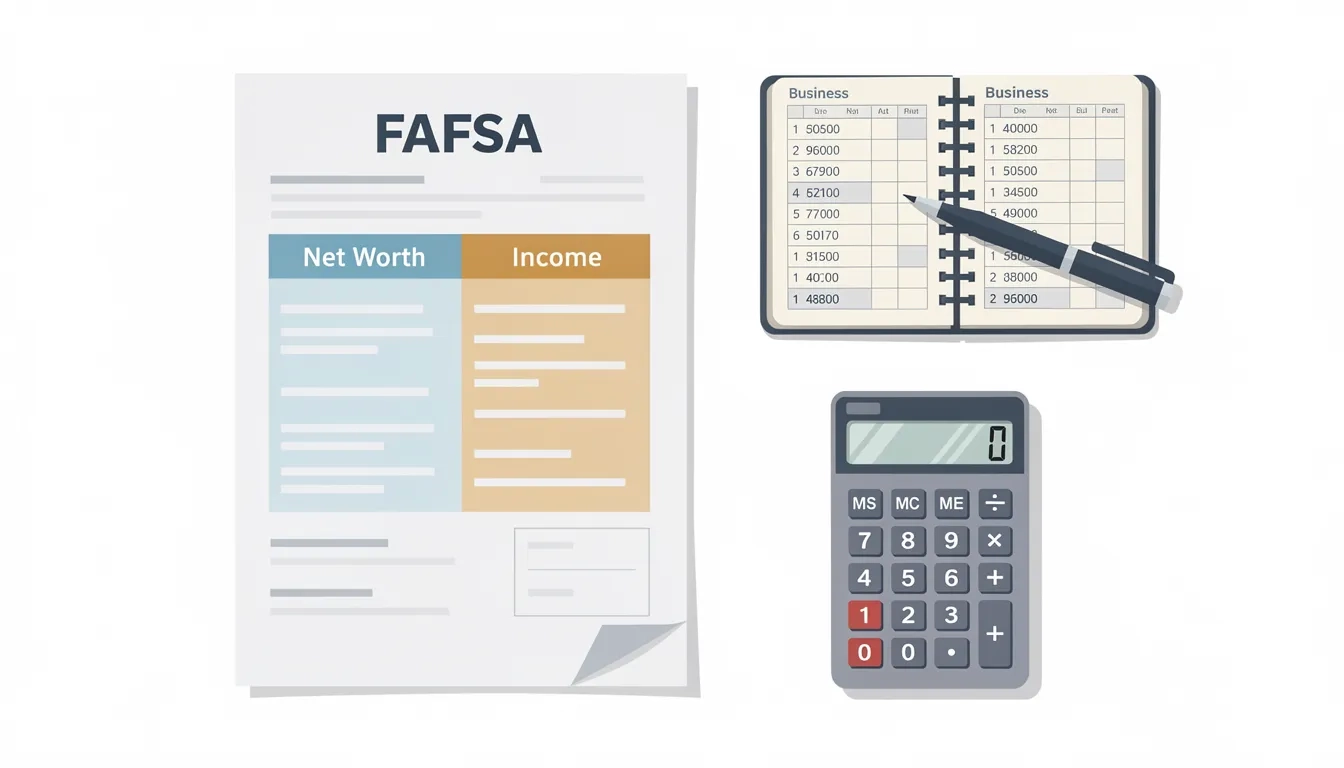
Most families who own a business assume FAFSA will hurt them. Some are right. But the specific damage — and the specific protections available — have shifted dramatically in the last three years, and knowing which version of the rules applies to your award year can mean the difference between qualifying for substantial aid and getting nothing.
What FAFSA Actually Measures When You Own a Business
The form is looking at two things: your business's net worth as an asset, and your business income as part of your household's total income picture. These feed into your Student Aid Index (SAI) through completely different channels, and they hit at very different rates.
Net worth is calculated as the fair market value of everything the business owns — land, buildings, inventory, equipment, vehicles, machinery — minus any debt secured by the business itself. That last part matters. If you took a home equity line of credit to fund your LLC, that loan doesn't reduce the business's FAFSA value. It's secured by your house, not your company, so FAFSA treats the loan as separate.
Income comes through your tax return. Sole proprietors report on Schedule C; S-corp and partnership owners receive a K-1. Any salary your family members draw from the business also shows up. And here's the part many families don't realize: FAFSA no longer relies on what you write on the form for income. The IRS's Direct Data Exchange system links FAFSA directly to your federal tax data. Business income you've already reported to the IRS is pulled automatically.
Why Business Income Usually Does More Damage Than Business Assets
This is the insight most business-owning families miss entirely, and it's worth slowing down on.
Under the SAI formula, parent-owned assets are assessed at roughly 12 cents on the dollar. A business with $250,000 in net worth might increase your expected contribution by around $30,000. That sounds painful, but it's spread across all college enrollment years — for a four-year school, that's roughly $7,500 per year in added expected contribution from those assets.
Business income is a different animal. Above the income protection allowance (set at $35,870 for a family of four with one student in college for the 2025-26 cycle), parental income is assessed on a progressive scale that peaks at 47%. A year where your business generated an extra $100,000 in taxable profit can reduce aid eligibility by $40,000 to $47,000 — in a single year.
Here's how the assessment rates compare:
| Factor | Who Owns It | Assessment Rate |
|---|---|---|
| Business / other assets | Parent | ~12% |
| Business / other assets | Student | 20% |
| Available income (above protection allowance) | Parent | Up to 47% |
| Available income | Student | Up to 50% |
The student column creates a trap that surprises families. If a student is on the business payroll and saves those wages, those funds count as student-owned assets — assessed at 20%, which is higher than the parent asset rate. Routing payroll through a student's name to help them build savings can quietly work against you on the FAFSA.
The Small Business Exclusion: Eliminated, Then Restored
For most of FAFSA's history, families who owned businesses with fewer than 100 full-time employees didn't have to report business net worth as an asset at all. The exclusion was a quiet but significant protection — essentially invisible to families who never lost it.
The FAFSA Simplification Act removed it. Starting with the 2023-24 award year, the exclusion was gone. Every business, regardless of size, had to be disclosed. Families who had been counting on that protection found themselves suddenly exposed, and those with asset-heavy businesses (farms, construction companies, equipment-intensive operations) saw the biggest impact.
"For three consecutive award years — 2023-24, 2024-25, and 2025-26 — the value of a small business counted against families who had spent years planning around the assumption it wouldn't."
The good news is that the exclusion is coming back. Through federal legislation (referenced in federal student aid guidance as the OBBBA provision), the small business exclusion is restored starting with the 2026-27 award year. Applications for that cycle opened in October 2025. Qualifying business-owning families no longer have to report business net worth as a FAFSA asset.
Who Actually Qualifies for the 2026-27 Exclusion
Not every business owner clears the bar. The requirements are specific, and a few details catch families off guard.
To qualify for the small business exclusion, the business must:
- Be family-owned and family-controlled
- Have the family holding more than 50% of voting rights — a straight 50/50 split does not qualify
- Employ 100 or fewer full-time equivalent employees
- Or qualify as a family farm where the family lives on the property, or a family commercial fishing operation
That majority-ownership requirement cuts out more families than you'd expect. A common business structure — one family member partnering equally with a non-family investor or co-founder — fails the test. FinAid.org, which publishes detailed breakdowns of FAFSA asset rules, notes that the threshold is specifically "more than 50%" of voting rights, so equal partnerships don't qualify even if both partners are otherwise good actors.
What the exclusion does NOT cover:
- Business income of any kind (Schedule C profit, K-1 distributions, family member salaries)
- Rental properties (these are investment assets, always reported)
- Businesses with more than 100 full-time equivalent employees
- Business debt secured by personal property rather than the business itself
Qualifying for the exclusion doesn't make the business invisible. A service firm with $50,000 in equipment but $280,000 in annual profit still has that income running through the SAI formula at rates up to 47%. The exclusion shields the valuation of the business — not the cash flow it produces.
The Rental Property Trap
Many families conflate owning rental properties with owning a business. On the FAFSA, these are completely different categories.
Rental properties are investment assets, not business assets. Their net worth — fair market value minus the outstanding mortgage — must be reported on the FAFSA regardless of which exclusion applies to your operating business. A family with two rental properties worth $200,000 net is looking at roughly $24,000 added to their expected parent contribution from those assets alone.
There is a narrow exception (one that very few families meet): if a family materially participates in managing a substantial portfolio of rental units as their primary business activity, those properties may be classified as business assets. A landlord managing 20 rental units full-time might qualify. A family with one investment condo almost certainly doesn't.
The working rule: if you don't live there and it generates rent, FAFSA treats it like a brokerage account.
A Practical Filing Checklist for Business-Owning Families
Award year determines everything. Here's a clear sequence:
- Confirm your award year first. For 2025-26, you're still in the window where all business assets must be reported in full. For 2026-27 and beyond, the exclusion applies if you meet the criteria.
- Calculate business net worth precisely. Fair market value of all assets minus only the debt secured by the business itself. Overreporting net worth isn't neutral — it costs you.
- Pull your operating agreement. Verify that the family's voting-rights stake exceeds 50%. Don't assume; check the actual document.
- Identify the income year. FAFSA uses income from two prior years. A 2026-27 application draws on 2024 tax data. A strong 2024 for the business will show up in the SAI even if 2025 and 2026 were leaner.
- Track rental properties separately. They need their own net worth calculation, independent of any business exclusion.
- Review student wages from the business. Wages saved by a student become student-owned assets assessed at 20%. That may or may not be preferable to leaving the money in the business, depending on total asset picture.
Three Misconceptions That Cost Families Aid
Misconception 1: Entity structure protects you. LLC, S-corp, C-corp — none of these shield assets from FAFSA reporting. The form looks through entity structure to the family's ownership stake and counts the underlying net worth. The exclusion is based on employee count and family control, not how the business was organized at the county clerk's office.
Misconception 2: The exclusion makes the business disappear. It removes the appraised net worth from the asset calculation. That's the whole scope of it. A consulting business with no physical assets but strong annual income may barely benefit — the income still runs through the SAI at the same marginal rates. Families with asset-heavy, income-moderate businesses gain the most from the exclusion restoration.
Misconception 3: Income you don't mention won't be seen. The Direct Data Exchange pulls tax data automatically. Business income reported on a Schedule C or K-1 is verified against IRS records. Self-reported asset values are a different matter, but income is not something families can strategically omit.
My honest take: most business-owning families focus on the wrong variable. The asset question matters, but the income question typically does more damage per dollar. A farm with $800,000 in land and equipment but modest annual profits looks very different on a FAFSA than a management consulting firm with zero tangible assets and $350,000 in annual Schedule C income. Know which type of business you have before deciding how much the exclusion actually moves the needle for you.
Bottom Line
The 2026-27 restoration of the small business exclusion is real relief for the right families — specifically those with asset-heavy operations, majority family ownership, and 100 or fewer employees. For many other business owners, the income picture dominates, and the exclusion changes less than they hope.
- Know your year: 2023-24 through 2025-26 required full business asset disclosure; 2026-27 restores the exclusion for qualifying businesses
- Confirm majority ownership: more than 50% family voting control is required — a 50/50 partnership doesn't qualify
- Use only business-secured debt to reduce your reported net worth
- Plan around the income year: FAFSA draws on two-year-prior returns, so a strong profit year follows you into future applications
- Don't conflate the exclusion with income protection — business profits still run through the SAI formula at rates reaching 47%
Frequently Asked Questions
Does the type of business entity (LLC, S-corp) affect how FAFSA treats my business?
No. FAFSA looks through the legal structure to the underlying ownership and economics. An LLC's assets count the same as a sole proprietorship's assets. The small business exclusion is triggered by employee count and family ownership percentage — not by how the business is organized or taxed. Forming an LLC specifically to avoid FAFSA reporting doesn't work.
Can I reduce my business's reported net worth by taking on debt?
Only if the debt is secured by the business itself. Loans backed by business real estate, business equipment, or a business line of credit can offset the asset value. A home equity loan used to fund the business — secured against your house — does not reduce the business's FAFSA net worth. Be precise about this distinction; it's one of the more commonly misapplied rules.
My business had a great year two years ago but is struggling now. Does that hurt us?
Yes, because FAFSA uses prior-prior-year income. For a 2026-27 application, the income figure comes from your 2024 tax return. If 2024 was a strong year and 2025-26 have been harder, your SAI will still reflect that peak income. There's no mechanism to adjust for current-year business conditions on the standard FAFSA form. This is one of the stronger arguments for appeal to the financial aid office, which can sometimes use professional judgment to adjust the formula.
Is a family farm treated the same as a small business?
Not exactly — family farms where the family lives on the property qualify for the 2026-27 exclusion even without the 100-employee test applying specifically to them. The farm exclusion has its own track. Commercial fishing operations operated by the family are similarly carved out. The income from those operations still counts; only the asset value of the farm or vessel gets excluded.
What if I co-own the business 50/50 with my spouse?
If both owners are family members in the household (spouses counted together), the family controls 100% of the business, and you qualify for the exclusion on the ownership-control test — assuming the employee count criterion is also met. The problem arises when the other 50% belongs to a non-family business partner. In that case, the family doesn't hold "more than 50%" of voting rights, and the exclusion doesn't apply.